Samuel Alito Quotes
I’m reminded of an experience I had ... in a museum in Berlin. One of the exhibits was a rustic wooden cross. A ... woman, and a young boy were looking at this exhibit. And the young boy turns to the woman, presumably his mother, and said: “Who is that man?” That memory has stuck in my mind as a harbinger of what may lie ahead for our culture. And the problem that looms is not just indifference to religion, it’s not just ignorance about religion. There’s also growing hostility to religion... .
A dominant view among legal academics is that religion doesn’t merit special protection... . A liberal society, they say, should be value-neutral, and therefore it should treat religion just like any other passionate personal attachment—say, rooting for a favorite sports team, pursuing a hobby, or following a popular artist or group. Now, I think we would all agree that in a free society, people should be free to pursue those avocations. But do they really merit the same protection as the exercise of religion?
Alito speaking at the University of Notre Dame Law School’s Religious Liberty Summit in Rome, July 21, 2022.


This Sura of the Koran warns the faithful that the non-Muslims of the world have as a major objective the Conversion of Muslims. While this was and has been the case in times past starting even before the Crusades, many Christians felt it as an obligation to either convert the Muslims or to kill them. In modern times there have been Christian missionaries who have had an objective of converting Muslims, but no Christian government has had that as a policy for a long time now. But most Muslims are told this is so today and the Koran warned of this. The result is that many Muslims—particularly those who have not had much contact with other religions—believe that because of this, they will be forever fighting heretics like Christians. For this reason, Islam’s future is under attack.

This absurd law was in existence for 22 years. But its vestiges lasted for over 100 years. It was not until the 1880s that it became fashionable to celebrate Christmas in Boston. The founding fathers were well aware of many early American laws interfering with religion and many religious laws interfering with those who did not believe a particular doctrine. The separation of church and state evolved from years of European abuses and American abuses as well.


Hume is one of the first to observe that if a society would be religiously pluralistic, the ruler and government had best separate itself from all of the religions. He uses the phrase “preserve a very philosophical indifference.” The Founding Fathers were familiar with Hume’s work and of his treatises were available to them in a Philadelphia library during the Constitutional Convention in 1787.


He is a Greek Orthodox Christian, and he correctly observes that the Islamic world was considerably more tolerant than the Christian until the 18th century when Islam had become less tolerant in the Middle East while the Christians were modernizing and going through a cultural and intellectual enlightenment and societal modernization while the Muslims, became less tolerant than they were in earlier years leading to the modern situation.
Other vibrant democracies also have such restrictions on freedom of speech such as Germany and Israel.

Samuel Langhorne Clemens, 1835-1910

This quotation is important because it emphasizes an aspect of freedom of religion that is not usually discussed—the freedom to LEAVE a religion. As an Islamic reformer born in Iran, this notion is extremely important. Under Sharia—Islamic Law—capital punishment is required for anyone who converts from Islam to any other religion. This has been made a part of the civil law of many Islamic nations from Afghanistan to Saudi Arabia as well as Iran where Sharia IS the civil law. There is no other religion in the world which makes conversion away from the religion a capital crime requiring execution. Executing people who leave a religion is a major violation of the Universal Declaration of Human Rights.

Spinoza was one of the most feared intellectuals in human history—feared that is by the established power structures. He is the only known person who was excommunicated by the Catholics, the Jews and the Muslims—all were forbidden to read his works. He was the enemy of authority and advocated personal reason as the guide for men.

Porush was one of the Haradi--ultra-orthodox Jews. In the land of the Jewish people, he argued against religious freedom for Jews unless they were Orthodox Jews, while ironically, the majority of Jews in the world and even in Israel followed the Conservative or Reform branches of Judaism or were secular. At the time the Orthodox Jewish movement was the only one that was recognized officially by the government. Porush and some of the more fanatical Haradi were determined to keep the Conservative and Reform Jewish branches unrecognized and unsupported by the government. (Israel does not have separation of church and state and economically supports the Orthodox Jewish establishment but not the other majority branches of Judaism.) The "Women of the Wall" is one of the major groups in Israel advocating equal government treatment for all citizens o0f Israel. Orthodox Judaism, like many other orthodox religions are very sexist and women were actually banned from praying at the holiest of Jewish places, the Western or Wailing Wall. Women of the Wall had won a major decision of the Israeli Supreme court that women could not be denied the right to pray at the Wall. The orthodox rabbis who the government allowed to control access to the Wall, set aside a small area for women at the "Dung Gate" where the garbage was carried out. Women of the Wall were back in court and this prompted Porush's outburst. He was cebsured by the Ethics Committee of the Israeli Knesset (Parliament).

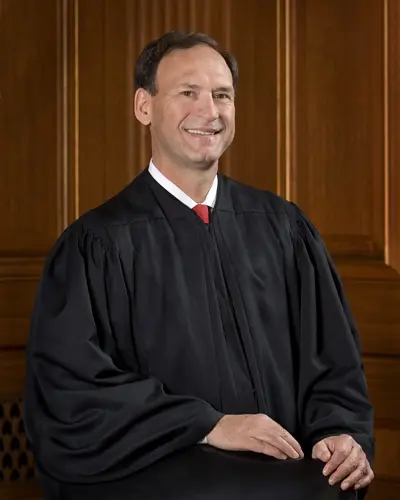
Samuel Anthony Alito Jr. is an associate justice of the Supreme Court of the United States. He was nominated by President George W. Bush on October 31, 2005, and has served since January 31, 2006. He is the second Italian-American justice to serve on the Supreme Court, after Antonin Scalia, and the eleventh Roman Catholic.
