Michael Hayden Quotes
I'm not hugging the Guantanamo location, but our right to hold people under the laws of war as enemy combatants, I think, is unarguable, and we need to stand up for that.
Hayden, Michael. Interview by Chris Wallace. Fox News Sunday, Fox News, 14 Feb. 2010.


The problem that was facing the nation in the early 21st century was when we captured a terrorist, was he a combatant or was he accused by a personal enemy, and had he been tortured to say he was a terrorist. The issue grew more complicated when terrorist suspects were brought to American territory at Guantanamo Bay, and the Courts have always held that a foreigner on American soil had a right to have access to the Federal Courts just as Citizens do. Complicating the situation more was the fact that a few American citizens had joined the terrorists and were they entitled to a civilian trial as all other Americans were.

The press were asking about the claim that the United States were sending detainees (“rendition” it is called) in the War on Terrorism to countries where they are tortured in ways that United States law prohibited. This quotation is an excellent illustration of the nuanced language that is sometimes used by politicians with the press. For example this statement was made in the Press Conference about our Human Rights Annual report. In it specific countries were named and accused of torturing prisoners or suspects. The press had learned that detainees had been renditioned to those same countries. Lowenkron went on to explain that U. S. officials had explained to officials of the countries to which detainees had been renditioned that the detainees should not be tortured; therefore they did not BELIEVE that they would be. So the statement was “correct” whether or not they detainees had been tortured. In another nuance, some people wondered what “we” meant—the United States or the State Department. Perhaps the State Department followed this policy and practice but the CIA may not have.

The Justice Department and the White House were arguing that the Geneva Conventions did not apply to terrorist groups. See {589865}.

There has always been some confusion in the case of the Wars in Afghanistan and Iraq. The Geneva and Hague conventions are very clear when prisoners are official members of an state’s armed force with uniforms, insignia and ranks. It is also clear with respect to civilians. But the combatants of the insurgent and terrorist forces fall in between, and international law is less clear. The George W. Bush administration at first took the position that the captured combatants were not captured soldiers and were therefore not entitled to the treatment due that status. But the military regulations made no distinction as to how prisoners in combat should be treated. It is a very gray area, except that in either case, torture is illegal under U. S. and under International law.

The American military and CIA officials made a number of errors in dealing with some of the prisoners. Once military desecrated a Muslim Holy Book with urine, many or the active and violent prisoners were kept in solitary confinement, but secrecy allowed Islamic propagandists to claim that this was done with almost all. Worst of all CIA interrogators were allowed to use ‘enhanced techniques’ (torture). Prisoners were not allowed to have reasonable contact to attorneys and where there were, these were monitored. Most of the prisoners were never charged with anything and yet they never received sentences and no one had any idea whether or not they would ever be charged, tried, sentenced or released. Even where there were some prisoners that the American authorities were willing to release, only a few were as their original counties would not accept them. Islamic extremist terrorist recruiters use Guantanamo to propagandize against America, and many new terrorist recruits were primarily motivated they claimed by the way that fellow Muslims had been treated in Guantanamo. Almost all agreed that Guantanamo was a negative, but it became very difficult to close it down and despite all the errors of operation, very few Americans were willing to return all these men to the battlefield to re-jojn the terrorists and other countries were unwilling to take the responsibility for their custody.


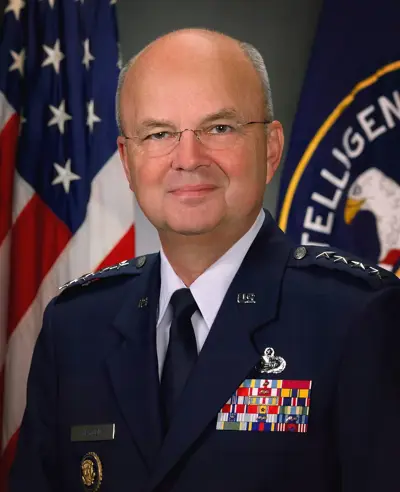
Michael Vincent Hayden is a retired United States Air Force four-star general and former Director of the National Security Agency, Principal Deputy Director of National Intelligence, and Director of the Central Intelligence Agency. Hayden currently co-chairs the Bipartisan Policy Center's Electric Grid Cyber Security Initiative. In 2017, Hayden became a national security analyst for CNN.
