Sun Tzu Quotes
If we know that our own men are in a condition to attack, but are unaware that the enemy is not open to attack, we have gone only halfway towards victory.
Sun Tzu. The Art of War. Translated by Lionel Giles, Luzac & Co., 1910, p. 109.


Plan Orange was the code name of the united states plan for possible war with Japan. In this ironic quotation, American military planners realized five years before Pearl Harbor that surprise attack was the major vulnerability. We were surprised and had no help from our intelligence service which despite the recommendations was almost nonexistent.

He was a strong believer in surprise attack and preemption.

Referring to Lincoln's Secretary of War, Edwin M. Stanton, who was a forceful administrator constantly telling all others what to do:

During his revolutionary battles in Kaingsi, Mao reduced his theory of guerrilla tactics to a poem:

Referring to the Joint Committee for the Conduct of the War—the unit of Congress that scrutinized and often tried to micro-mange Abraham Lincoln's efforts:

Despite the Muslim perception of the role of women, Tamerlane’s nomadic tradition had women warriors and he used them to guard the camp and freed up the men.
Although jihad was a duty of Muslims, it was not a duty to die in a fight against overwhelming odds which was determined to be 2 to 1. So 2 Muslims could run from 4 but not 3.

See {637854} for a quote on the soundness of our military planning.
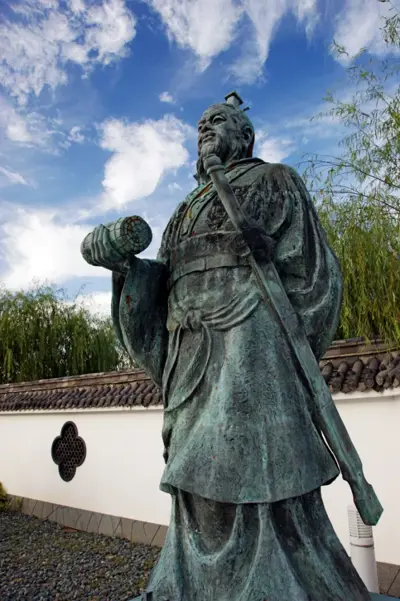
Sun Tzu was a Chinese general, military strategist, writer, and philosopher who lived in the Eastern Zhou period of ancient China. Sun Tzu is traditionally credited as the author of The Art of War, an influential work of military strategy that has affected both Western and East Asian philosophy and military thinking. His works focus much more on alternatives to battle, such as stratagem, delay, the use of spies and alternatives to war itself, the making and keeping of alliances, the uses of deceit, and a willingness to submit, at least temporarily, to more powerful foes. Sun Tzu is revered in Chinese and East Asian culture as a legendary historical and military figure. His birth name was Sun Wu and he was known outside of his family by his courtesy name Changqing. The name Sun Tzu by which he is best known in the Western World is an honorific which means "Master Sun".
