Paul Bremer Quotes
If they [terrorists] see a Western hostage can be sold for a couple of million dollars, they may conclude that by holding on to an American, they'll get some money out of us.
Alluding to French willingness to pay ransom for hostages:
L. Paul Bremer, U. S. Ambassador-at-Large for Counterterrorism (Republican), Occupation Administrator of Iraq, Quoted in New York Times, October 10, 1988
Sourced by: Eigen's Political and Historical Quotations


She served as the head of the Task Foce that the President asked to come up with better poliocies and procedures for coping with situations were Americans were being held hostage for ransom. The poliocy had been that the United States would not pay meny for hostages and it was a crime for the families and friends to do so. After the report, the government still would not pay terrorists for hostages, but the new policy allowed family and friends to do so if they wanted. A number of Amricans have been murdered when hostage money was not paid. Some argue that the government should pay the ransom lest life and death depend on the wealth of the family of the victim. Most terrorism experts argue against paying at all. In addition to encouraging the terrorists to take more Amercian hostages, the hostage money goes to the terrorists who use it to endanger and kill other Americans. There is no good answer to this situation.


Islamic Religious Fundamentalist Terrorists in Algeria had kidnapped over 100 Western Hostages including some Americans. One of the terrorist’s “demands” was for the release of convicted murderers and terrorists in the United States. The official policy which she stated was not totally accurate. On several occasions, U. S. Officials or third parties representing them had “unofficially” negotiated with terrorists. In many cases this was a tactic to buy time and military action followed and in other cases unofficial ransoms were actually paid. The United States has had to contend with this problem with Islamic Terrorists and Pirates since the Thomas Jefferson Presidency when he argued against John Adams who wanted to pay the tribute while Jefferson preferred military action.

For the last 300 years, Muslim terrorists—corsairs at sea and petty tribal leaders on land—have made a lucrative business of kidnapping people and holding them for ransom. When Thomas Jefferson went to war off the Barberry coast, the Americans were the only Western nation who did not want to appease the terrorists and pay the ransoms or pay an annual “tribute” to guarantee safe passage (protection money). The European powers at the time and since could crush the terrorists militarily but there would be an economic cost for the expedition and lives would be lost. The typical calculus was that it was cheaper to pay the ransom than to pay the cost of a military solution. Even the United States then paid the yearly tribute for a while. However, this has reinforced the hostage taking behavior over the years and it is still in force. While the United States has a policy against paying ransoms, our government maintains a blind eye to private citizens, families or private companies paying to free the hostages. The Europeans, in contrast, generally allow even the government to pay ransoms. Weddady and other Muslim leaders have and continue to urge a policy of no ransom and use of force wherever possible. Muslim nations like Algeria and Turkey have learned that this is the best way to handle kidnapping terrorists and every few years, new terrorists try again and they attack quickly. In contrast European hostages are taken by the hundreds throughout the year. Meanwhile, piracy and hostage taking for ransom has spread to some Asian cultures so the world problem is not uniquely with Muslim terrorists any longer.

By paying kidnappers who hold Americans hostage for ransom, the United States would just be encouraging the kidnappers and produce more kidnapping. However in some hostage situation, especially with ISIS and other terrorists the refusal to pay ransom means a horrible and cruel death for the American kidnap victims. Many of the European nations tend to secretly pay the hostage takers just as they were will to pay the Barbary Pirates and Corsairs in the 18th century. There is no right answer other than to defeat the terrorists and put them out of business.


Islamic extremists had killed thousands on Russian citizens and military men in Chechen, one of the states in Russia. At the time--before 9-11--Americans in the homeland had never been attacked by Islamic religious extremists as the Russians had. Some Americans were very critical of the Russians for using force and troops to deal with the terrorists and urged Putin to negotiate. This was Putin's reply. It was taken by many Americans as an unnecessarily hard line then. After 9-11, however, American views towards negotiations with terrorists generally resembled Putin in this quotation. Many Americans then developed much more sympathy with the Russian position on terrorism inside Russia.

Asked if he would relent in his attitude toward Iraqi President Saddam Hussein if the Iraqi leader would free American hostages and make concessions:
The President had cut some programs that were Congressional favorites:

In 1904 a naturalized American citizen, Ion Perdicaris, was kidnapped and held for ransom by Achmed Ben Mohammed Raisuli, a Moroccan warlord and descendent of the Prophet Mohammad. Raisuli had made a series of economic and political demands on the Sultan of Morocco who was dragging his feet in dealing with the problem. The administration ordered a naval warship to stand off the coast of Morocco and this ultimatum was dispatched to the Sultan of Morocco, and was read aloud from the platform of the Republican National Convention in Chicago which was in the process of renominating Theodore Roosevelt for a second term as president. Two days later Perdicaris was released. Kidnapping to intimidate has been a classic Arab terror political and quasi military technique as well as one for pure economic greed.


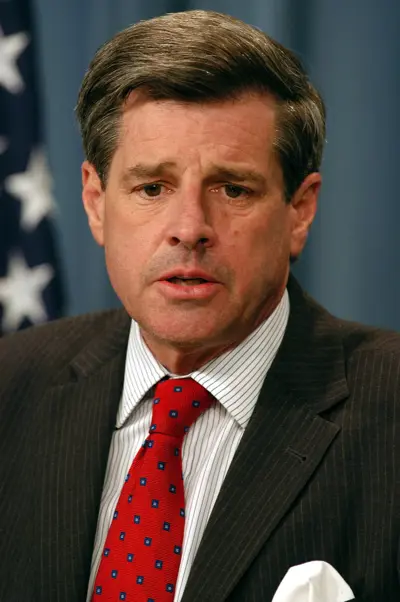
Lewis Paul "Jerry" Bremer III is an American diplomat. He led the Coalition Provisional Authority (CPA) following the 2003 invasion of Iraq by the United States, from May 2003 until June 2004.
