John Hay Quotes
We want Perdicaris alive or Raisuli dead!
In 1904 a naturalized American citizen, Ion Perdicaris, was kidnapped and held for ransom by Achmed Ben Mohammed Raisuli, a Moroccan warlord and descendent of the Prophet Mohammad. Raisuli had made a series of economic and political demands on the Sultan of Morocco who was dragging his feet in dealing with the problem. The administration ordered a naval warship to stand off the coast of Morocco and this ultimatum was dispatched to the Sultan of Morocco, and was read aloud from the platform of the Republican National Convention in Chicago which was in the process of renominating Theodore Roosevelt for a second term as president. Two days later Perdicaris was released. Kidnapping to intimidate has been a classic Arab terror political and quasi military technique as well as one for pure economic greed.
John Milton Hay, 1838-1905, U.S. Ambassador to Great Britain, U. S. Secretary of State, Assistant and Secretary to the President [Abraham Lincoln], Cable to the Sultan of Morocco, June 1904
Sourced by: Eigen's Political and Historical Quotations


She served as the head of the Task Foce that the President asked to come up with better poliocies and procedures for coping with situations were Americans were being held hostage for ransom. The poliocy had been that the United States would not pay meny for hostages and it was a crime for the families and friends to do so. After the report, the government still would not pay terrorists for hostages, but the new policy allowed family and friends to do so if they wanted. A number of Amricans have been murdered when hostage money was not paid. Some argue that the government should pay the ransom lest life and death depend on the wealth of the family of the victim. Most terrorism experts argue against paying at all. In addition to encouraging the terrorists to take more Amercian hostages, the hostage money goes to the terrorists who use it to endanger and kill other Americans. There is no good answer to this situation.

By paying kidnappers who hold Americans hostage for ransom, the United States would just be encouraging the kidnappers and produce more kidnapping. However in some hostage situation, especially with ISIS and other terrorists the refusal to pay ransom means a horrible and cruel death for the American kidnap victims. Many of the European nations tend to secretly pay the hostage takers just as they were will to pay the Barbary Pirates and Corsairs in the 18th century. There is no right answer other than to defeat the terrorists and put them out of business.


The quotation is notable as it illustrates the great difficulty that modern democracies have with extreme Islamic fundamentalists. Their very perception and world view is so different that often we think of the extremists as insane and they often feel the same way about us.


The Taliban terrorists would try and kill, kidnap and hold people for ransom following a Muslim tradition dating back to the Barbary Pirates. While there is always pressure to negotiate to alleviate the immediate situation, the negotiation is in and of itself, a reward for the terrorism. Hence the general’s rigid view.

The President had cut some programs that were Congressional favorites:


Islamic Religious Fundamentalist Terrorists in Algeria had kidnapped over 100 Western Hostages including some Americans. One of the terrorist’s “demands” was for the release of convicted murderers and terrorists in the United States. The official policy which she stated was not totally accurate. On several occasions, U. S. Officials or third parties representing them had “unofficially” negotiated with terrorists. In many cases this was a tactic to buy time and military action followed and in other cases unofficial ransoms were actually paid. The United States has had to contend with this problem with Islamic Terrorists and Pirates since the Thomas Jefferson Presidency when he argued against John Adams who wanted to pay the tribute while Jefferson preferred military action.
For the last 300 years, Muslim terrorists—corsairs at sea and petty tribal leaders on land—have made a lucrative business of kidnapping people and holding them for ransom. When Thomas Jefferson went to war off the Barberry coast, the Americans were the only Western nation who did not want to appease the terrorists and pay the ransoms or pay an annual “tribute” to guarantee safe passage (protection money). The European powers at the time and since could crush the terrorists militarily but there would be an economic cost for the expedition and lives would be lost. The typical calculus was that it was cheaper to pay the ransom than to pay the cost of a military solution. Even the United States then paid the yearly tribute for a while. However, this has reinforced the hostage taking behavior over the years and it is still in force. While the United States has a policy against paying ransoms, our government maintains a blind eye to private citizens, families or private companies paying to free the hostages. The Europeans, in contrast, generally allow even the government to pay ransoms. Weddady and other Muslim leaders have and continue to urge a policy of no ransom and use of force wherever possible. Muslim nations like Algeria and Turkey have learned that this is the best way to handle kidnapping terrorists and every few years, new terrorists try again and they attack quickly. In contrast European hostages are taken by the hundreds throughout the year. Meanwhile, piracy and hostage taking for ransom has spread to some Asian cultures so the world problem is not uniquely with Muslim terrorists any longer.

For years of the Arab-Israeli conflict, Palestinians would never negotiate with Israel over anything. Finally that barrier was broken and, the PLO became a negotiating party with Israel. However, the terrorist organization Hamas, had challenged the PLO for political control of the Palestinians and then took over the Gaza strip—part of the Palestinian territory. They then shot thousands of rockets into Israel, a clear act of war under international law. The Israelis then attacked the Hamas infrastructure and any building of facility where they had command or communications, meetings, trainings or stored weapons or ammunitions. The Gazans suffered many more casualties than the Israelis—about 20 to 1 ratio. Many other countries tried to broker a ceasefire which the Israelis agreed to but Hamas would not. The Israeli ambassador was asked on American television if Israel would be willing to negotiate on the larger issues of the conflict as they had negotiated with the PLO. This was his reply. The major problem was that the Hamas Charter had two clauses that made negotiations impossible. Hamas was committed to the destruction of Israel and would not agree that the Israel had a right to exist. Second, the Hamas charter called for the killing of Jews anywhere in the world—men, women and children. The Israelis asked what they would negotiate about given those two charter items and the Hamas terror history in killing as many Israelis as they could.

An assassin had tried to kill the archduke and failed. In response to the complaints the mayor changed the archduke’s route the following day when he was successfully assassinated provoking World War I.
Arguing for deploying American Homeland Security Personnel in foreign countries He was at the time Assistant Secretary of Homeland Security.


Arguing against proposals to have the FBI apprehend terrorists in foreign countries against the wishes of the sheltering country

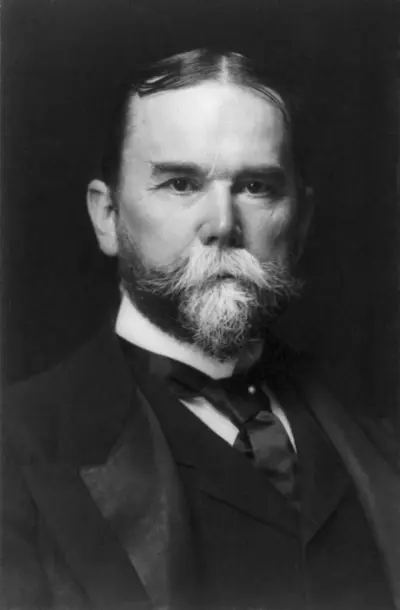
John Milton Hay was an American statesman and official whose career in government stretched over almost half a century. Beginning as a private secretary and assistant to Abraham Lincoln, Hay's highest office was United States Secretary of State under Presidents William McKinley and Theodore Roosevelt. Hay was also an author and biographer, and wrote poetry and other literature throughout much of his life.
