Rutherford B. Hayes Quotes
If the red-shirts can be present at the polls in South Carolina, why cannot the bluecoats [Federal troops] be called in also?
Hayes had been informed that South Carolina "Red Shirts"—an armed band organized to restore white supremacy in their state—controlled the elections. This was his reaction.
Rutherford B. Hayes, 1822-1893, 19th President of the United States (Republican, OH), Diary, March 23, 1879
Sourced by: Eigen's Political and Historical Quotations


Bruce was the first Black to complete a full term in the Senate

They were voting on ignoring the fraudulent vote count in Dallas County, Alabama. The counter argument was that it would disenfranchise those honest voters of the country whose votes would not then be counted.

A counter ethical argument says that voter suppression is ethically no different from gerrymandering, or having too few locations for voting, or voting on a Tuesday where poor people cannot often get to the polls with work and/or child obligations. For Republicans to suppress Black voting is only logical since such a high percentage of Blacks vote Democratic. It would be the same if Democratic legislatures could make it difficult for business executives to vote. It part of the rough and tumble reality of American politics.

The all white regular Mississippi Delegation was selected in elections where Blacks were barred from voting although Blacks were in the majority in Mississippi. In addition, the regular party was advocating obstructing the Supreme Court school integration decisions and the Civil Rights Act that had just been passed. See {637616}. The insurgent group was selected in integrated elections, contained black and white delegates, and was pledged to support and obey the laws. The President could not make the decision unilaterally, but had a great deal of influence.


The marshal was embarrassed by his assignment to arrest this famous, elderly woman. He refused to handcuff her, gave her time to change her clothes, and took Anthony by streetcar to the courthouse trying to keep as low a profile as possible while Anthony was making speeches all the way about her unjust arrest. She was found guilty and fined $100 which she never paid.
The President was asking for passage of his Voting Rights Bill.

In the beginning of the 21st century, many republican state legislatures attempted to change the voting laws to eliminate the possibility of voter fraud which was not a serious practical problem in America. However, a consequence—some argue indented and some argue unintended—was that it was harder for certain groups of people to meet the new requirements and therefore was a de facto voter suppression for some people such as the very elderly, the homeless, and the poor. Many of these efforts were declared unconstitutional by the courts.

The law required voters to have a driver’s license or other picture ID issued by the Motor Vehicles Bureau. 300,000 adults in the state did not have a license. They tended to be more frequent among the poor, the elderly, and the minorities.
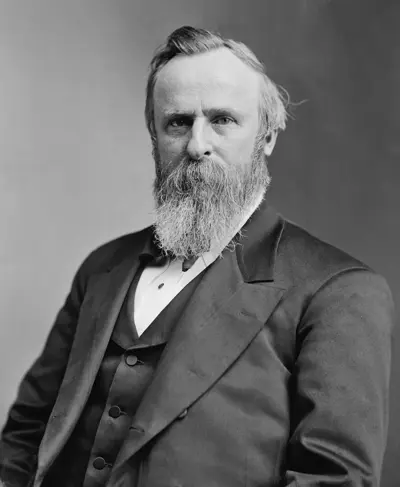
Rutherford Birchard Hayes was an American politician and attorney who served as the 19th president of the United States from 1877 to 1881, after serving in the U.S. House of Representatives and as governor of Ohio. A lawyer and staunch abolitionist, he had defended refugee slaves in court proceedings during the antebellum years. He negotiated the political agreement to end federal support of Reconstruction.
