Peter Bergen Quotes
If the CIA and other U.S. intelligence agencies were private companies and were chronically unable to accomplish one of their key missions, their shareholders would have long ago revolted, fired their management, and their stock would be trading at values near zero.
Bergen, Peter. "Time to hold intelligence agencies accountable." CNN, Cable News Network, 5 Jan. 2010.


When he became a candidate, he modified this position and stated that he would abolish both agencies spying on Americans activities but not necessarily abolish all the functions of the agency.


The scandals of the past of CIA lies to Congress and the President, mistakes they had made, and a raft of illegal activities, had eroded support for the agency. The reason for the minimal funding was that, and not the lack of interests. We still had the NSA and the Military Intelligence Agencies which had not been involved in the CIA scandals

The scandals of the past of CIA lies to Congress and the President, mistakes they had made, and a raft of illegal activities, had eroded support for the agency. We still had the NSA and the Military Intelligence Agencies which had not been involved in the CIA scandals.


Expressing concern over President Obama extending some of the American citizen entitled privacy rights to foreigners. He was concerned that this might inhibit our spying efforts.


When Bob Casey was the CIA Director, he the declassification of all the operational files of the WWII Office of Strategic Service. The huge collection is referred to as Record Book 2.6


We tend to be hard on our intelligence agencies for a combination or reasons. Because much of their activity is secret and many of their successes are not known to the public. If they have a great success, the politicians generally take the credit. But if the intelligence agency makes a big error that causes a failure of some kind, a the politicians often violate the secrecy and blame the intelligence agencies. The Iraq Invasion of the George W, Bush administration was a good example. The President had received intelligence that Iraq was developing nuclear weapons. He invaded to prevent their being used. It turned ouit that there were no nuclear weapons at all, and the President and leaders of hs cabinet had misled, the people, the Congress, the UN and world opinion and started a war on false pretenses. The administration then went public about the intelligence failure. There was a great deal of intelligence that indicated that there were no Iraq nuclear program but these never reached the President, the military or the public. In addition, the intelligence agencies have missed some really major events, like the fall of the Soviet Union or the Chinese Communist victory in the Chinese Civil war. But intelligence is not an exact science; mistakes are inevitable, The politicians using the intelligence tend to think that intelligence estimates are more certaini than estimates can be. However the CIA in particular has had periods of rogue and illegal activities just which cause many citizens ro distrust them. They have illegally investigated Americans, actually conducted experiments with chemical weapons in American cities without any permission or authority, violated American law in the way they treat prisoners,and destroyed evidence, broken the law by conducting activities that Congress and the President had explicitly forbid. The FBI has also broken the law and spied on Americans who were critical of the government, and slandered the reputations of some Americans by “leaking” information that oftn was not even true. So the current intelligence have to bear the burden of their predecessors, but because of the secrecy, cannot take advantage of all the wonderful accomplishments and great sacrifices of many members of the intelligence agencies.

This was a critical shortcoming in that the NSA had the personnel for electronic intelligence. It was the major job of the CIA to place human agents—abroad—who could act as spies and/or recruit or manage spies.

While that is often true, there have been some cases in American espionage history where the CIA did vouch for and employ and bring into the United States war criminals and even agents who had murdered and tortured innocent Americans. See {633240} for one such example.

He was the Chairman of the Senate Judiciary Committee. The NSA had hacked into the servers of these firms and others that were located out of the country. (They would need to have a warrant if inside the country.) The companies had never known it until Edward Snowden made this practice public. The result was, the public was learning that there was no privacy in any of their e-mail, social media activity, exchange of photos or videos or anything else. The companies feared that this would then harm their business, and that the techniques NSA used to hack there servers would then be discovered and used by others to steal identities, credit cards and do such other damage to customers. Even if the particular hacking methods were not leaked to the bad guys, they, knowing that the servers were vulnerable, would be encouraged to work to figure it out.
He was the Chairman of the Senate Judiciary Committee.

This was one of the many major weaknesses of our Intelligence Agencies.

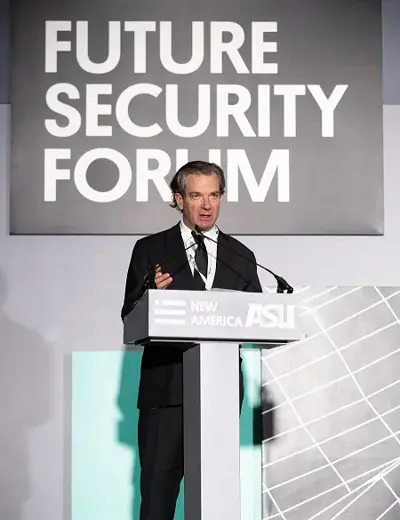
Peter Bergen is an American journalist, author, and producer who serves as CNN's national security analyst, New America's vice president, and as a professor of practice at Arizona State University. He produced the first television interview with Osama bin Laden in 1997. The interview, which aired on CNN, was the first time that bin Laden was interviewed by Western media.
