Juana Ines de la Cruz Quotes
If fathers wish to educate their daughters beyond what is customary, for want of trained older women and on account of the extreme negligence which has become women's sad lit, since well-educated older women are unavailable, they are obliged to bring in men teachers to give instruction in reading, writing, and arithmetic, playing musical instruments, and other skills…. As a result of this, many fathers prefer leaving their daughters in a barbaric, uncivilized state to exposing them to an evident danger such as familiarity with men breeds. All of which would be eliminated if there were older women of learning
Juana Ines de la Cruz, Mexican poet, scholar, nun and first literary figure in the New World, Letter to Sor Philothea
Sourced by: Eigen's Political and Historical Quotations


She was instrumental in outlawing slavery and two years after this speech she and her daughters appeared in public without the traditional Burka or veils. The conservative fundamentalists were outraged and they deposed her husband and her modern influence ended.


An “asp” was the term Greeks and Romans used for a poisonous snake. Menander was a very popular playwright 300 years before the birth of Christ. His phrase was not a new idea at the time but, common wisdom” among Greeks—including many women who were controlled by the social values of the day that were very sexist. However, when Menander wrote it, it received mass distribution in that plays were the major form of mass media and entertainment at the time. So this conventional wisdom was common as Rome became the superpower and whose culture dominated including the Greek plays. Note that this attitude did not reflect the point of view that women were not important enough to educate to write. To the contrary, the implication is that women were too potentially dangerous to allow them to learn to write. Upper class women however were expected to read, but men were not only taught to write but to do so persuasively.
This was written when Islam was intellectually far more advanced than Christian Europe. This viewpoint was one of the reasons for their advanced civilization. It was held by many. It is still held by many Muslims, but for the fundamentalist of Islam today, ignorance of anything that is not in the Koran or other sayings of the Prophet is a virtue. Madrassas throughout the Islamic world teach only the Koran and religious law and nothing of mathematics, philosophy, science, history and never of other religions.

England in contrast did not even educate many men in arithmetic and accounting and women not at all with the sexist English culture of the day. English merchants were notorious for selling their business at low prices as they got older unless they had an adult son with an aptitude for the business. The Dutch, with educated women could have a wife run a business if the husband died or was disabled, and allow children to grow up, thus keeping the business in the family, but more important for Holland, keeping the business thriving.

The number of women who studied Physics and sophisticated sciences in Germany at the time were few and far between. Ironically, Einstein married one of the few. However, the marriage failed for many reasons and his subsequent marriage was not to a scientist. Other conversations with him in later years revealed that his belief was that women were constitutionally unsuited to creative, theoretical science—Einstein’s type of science was almost purely abstract and mathematical. See {588596}.

The importance of women in the Hamas, fundamentalist vision is to function as a brood mare to “manufacture” men and then to bring them up which at least requires something more than their bodies. The role of women in producing other women however is never mentioned as important.


Even sophisticated societies have anti-intellectual movements. This happened in revolutionary France, but also at times even in the United States. In 2012, for example, Rick Santorum a candidate for the Republican presidential nomination called President Obama a “snob” for wanting to enable all students to go to college. Santorum was appealing to an anti-intellectual movement in the country that distrusted intellectuals as “elites.”


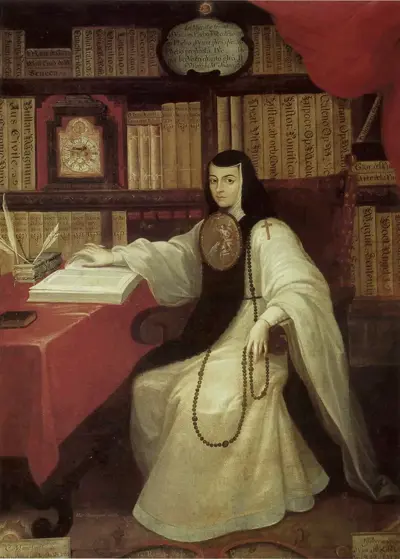
Sor Juana Inés de la Cruz OSH was a Mexican writer, philosopher, composer, poet of the Baroque period, and Hieronymite nun. Her outspoken opinions granted her lifelong names such as "The Tenth Muse" and "The Phoenix of Mexico", for she was a flame that rose from the ashes of "religious authoritarianism".
