Karl Marx Quotes
If emancipation of the working classes requires their fraternal conncurrence, how are they to fulfill that great mission with a foreign policy in pursuit of criminal designs, playing upon national prejudices, and squandering in piratical wars the people's blood and treasure? It was not the wisdom of the ruling classes, but the heroic resistance to their criminal folly by the working classes of England, that saved the west of Europe from plunging headlong into an infamous crusade for the propagation of slavery on the other side of the Atlantic.
Marx, Karl. Inaugural Address of the International Working Men's Association. Marx & Engels Collected Works, Vol. 20, International Publishers, 1985, p. 13.


During Southern slavery, the poor white of the South had almost no prospects. He was always competing against slave labor which held his wages very low. At first he could he could get by if he had a trade—a carpenter, a blacksmith, a teamster, etc. However, soon slave owners invested in training some of their slaves, so even a white Southern tradesman could not earn a high wage as a Northern tradesman did. Unfortunately, the Southern upper class persuaded the poor whites that if slaves were emancipated they would be greater competition than they were under slavery, and there never was the common interest with the Northern labor that Emerson hypothesized.


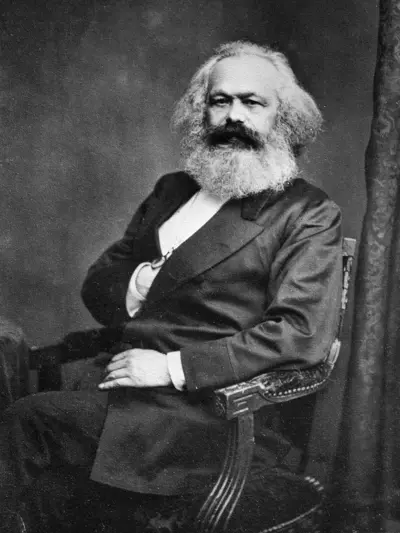
Karl Heinrich Marx was a German philosopher, economist, historian, sociologist, political theorist, journalist and socialist revolutionary. Born in Trier, Germany, Marx studied law and philosophy at university. He married Jenny von Westphalen in 1843. Due to his political publications, Marx became stateless and lived in exile with his wife and children in London for decades, where he continued to develop his thought in collaboration with German thinker Friedrich Engels and publish his writings, researching in the reading room of the British Museum. His best-known titles are the 1848 pamphlet The Communist Manifesto and the three-volume Das Kapital (1867–1883). Marx's political and philosophical thought had enormous influence on subsequent intellectual, economic and political history. His name has been used as an adjective, a noun, and a school of social theory.
