Hammurabi Quotes
If any one owe a debt for a loan, and a storm prostrates the grain, or the harvest fail, or the grain does not grow for lack of water; in that year he need not give his creditor any grain, he washes his debt-tablet in water and pays no rent for this year.
This is one of the earliest expositions of the legal and economic doctrine that if a borrower is made unable to pay the interest and principle of the loan by an act beyond anyone’s control. The obligation to pay for that year is cancelled. In modern times most cultures go the other way. When the banks caused the economic Meltdown of 2008, millions of Americans could not pay their loan obligations and mortgages. They received no relief whereas in the “primitive” world of 4,000 years ago they would have relief for that year. Note the subtle difference in Hammurabi {611462} where someone had prepaid and rented land for a year and the crop fails, and this situation where there is borrowed money.
Hammurabi, ~1755 BC-1713 BC, King of Babylon, Code of Hammurabi
Sourced by: Eigen's Political and Historical Quotations

Note the subtle difference between this situation where a man rents land for a year and takes the risk, and {630755} where there is a loan of a mortage in which case, relief of payment is given for the year.

This quotation illustrates the method by which the Ancient Jews (also modern ultra orthodox Christians and Jews coped with the problem of inequality of wealth and the problem of a permanent poor and debtor class. It was a form of redistribution of wealth. As a practical manner, this passage had a profound influence on the Jewish and early Christian cultures. Namely there was not a great deal of lending or borrowing amongst the Jews. However, Jews were able to obtain repayment for longer than the 7 years if they made a loan to foreigners. The early Christians had the same stricture. So Jews could lend money to Christians and Christians to Jews without being required to forgo collection ever 7th year. So for Christians, Jews were money lenders which is where the Jewish money lender stereotype had its origin.


The President had a series of radio talks to the people in which he addressed them directly and explained things as he then understood them.


The recruitment was successful and Michigan farm country became one of the hotbeds of the small but loud and virulent Posse Comitatus movement.

The Brown family were very wealthy. John was involved in many speculative enterprises, owned slaves, and had been in the slave trade, and then it had been outlawed in large part by the efforts of his brother, Moses Brown who was a staunch abolitionist and an officer of the Rhode Island Abolition Society. The quotation is important because one theory is that the only reason that the slave trade became illegal was because it was not very profitable due to the high cost and loss ratio and the competition from slaves who were born of slave mothers. So the slave trade was outlawed but not slavery which was so profitable. However, this quotation illustrates how profitable the slave trade was and the early legislation was therefore motivated by ethical and moral concerns.


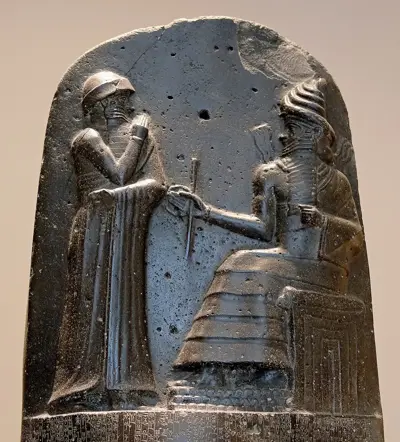
Hammurabi (c. 1810 – c. 1750 BC) was the sixth king of the First Babylonian dynasty of the Amorite tribe, reigning from c. 1792 BC to c. 1750 BC (according to the Middle Chronology). He was preceded by his father, Sin-Muballit, who abdicated due to failing health. During his reign, he conquered Elam and the city-states of Larsa, Eshnunna, and Mari. He ousted Ishme-Dagan I, the king of Assyria, and forced his son Mut-Ashkur to pay tribute, bringing almost all of Mesopotamia under Babylonian rule.
