Euripides Quotes
If all men saw the fair and wise the same men would not have debaters' double strife.
Euripides. The Phoenician Women. Translated by Arthur S. Way, Harvard University Press, 1912, p. 385.


The Vietnam War was raging and the country was polarized by it. The real issue of the time, as we were in the war, was whether we could better obtain peace by winning victories in the field causing the enemy to want to negotiate or to withdraw and produce peace unilaterally. In the end we tried a little of both reflecting the division in the nation. We succeeded at neither strategy and the polarization continued for many decades.

The debate had come to an impasse over the issue of voting and taxation by state equally or proportional to the population. Witherspoon warned of the consequence of there being no agreement on some form of unity.


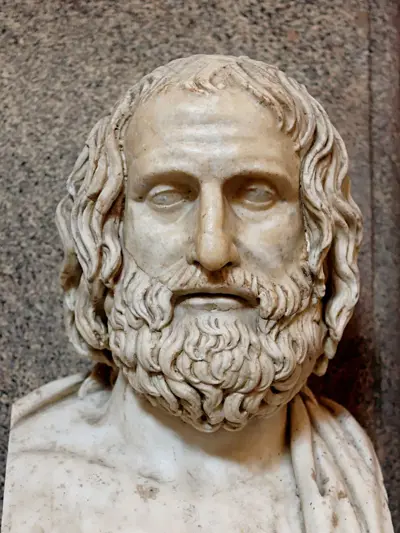
Euripides (/jʊəˈrɪpɪdiːz/; Greek: Εὐριπίδης Eurīpídēs, pronounced [eu̯.riː.pí.dɛːs]; c. 480 – c. 406 BC) was a tragedian of classical Athens. Along with Aeschylus and Sophocles, he is one of the three ancient Greek tragedians for whom any plays have survived in full. Some ancient scholars attributed ninety-five plays to him, but the Suda says it was ninety-two at most. Of these, eighteen or nineteen have survived more or less complete (Rhesus is suspect). There are many fragments (some substantial) of most of his other plays. More of his plays have survived intact than those of Aeschylus and Sophocles together, partly because his popularity grew as theirs declined—he became, in the Hellenistic Age, a cornerstone of ancient literary education, along with Homer, Demosthenes, and Menander.
