Milton Friedman Quotes
If a tax cut increases government revenues, you haven't cut taxes enough.
Friedman, Milton. "The Tax Revolt." Newsweek, 26 Jun. 1978.


This is the most articulate historical statement of the modern conservative mantra regarding taxes. However, one change has taken place. The words “necessarily” and “often” tend to be left out of the more modern ideological statements. Mellon’s original statement has never really had any politicians or economists who disagreed. Politicians of all economic persuasions have generally accepted the Mellon statement but the extreme conservatives’ creed is that a lowering of taxes always produces more revenue and a tax increase will inevitably lead to greater tax revenue—a position which Mellon never took. Mellon however was very solicitous of the wealthy, felt the welfare of the nation depended on their prosperity, and was a strong advocate of what was later called ‘trickle down’ economics {628592}.


The Laffer curve was a mathematical, economic curve supposedly showing the relationship between tax rate and government revenue from taxes. In Laffer’s version of this curve, as interest rates go down, revenue from taxes goes UP because according to Laffer, there will be much more economic activity if taxes are lowered. In reality this has happened rarely in certain countries and in a very narrow range of tax deduction. As Chretien observes if you lower the tax rate to zero according to the Laffer curve this should maximize revenue but obviously it does not because with a zero rate there are no taxes collected even if the economy is booming. The Laffer curve was ideologically popular with those politicians wanting to lower taxes, but it never stood up to serious analysis and never worked in practice as Chretien observes. As a result, some people refer to the curve as the Laughter curve.


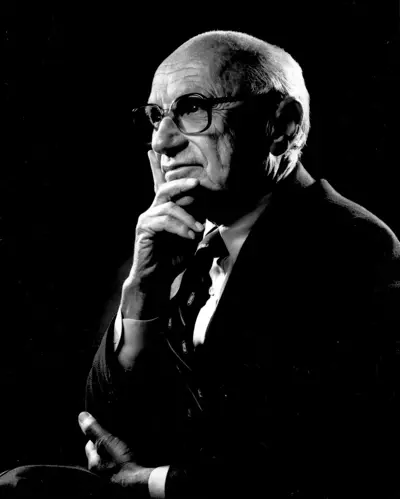
Milton Friedman was an American economist and statistician who received the 1976 Nobel Memorial Prize in Economic Sciences for his research on consumption analysis, monetary history and theory and the complexity of stabilization policy. With George Stigler and others, Friedman was among the intellectual leaders of the Chicago school of economics, a neoclassical school of economic thought associated with the work of the faculty at the University of Chicago that rejected Keynesianism in favor of monetarism until the mid-1970s, when it turned to new classical macroeconomics heavily based on the concept of rational expectations. Several students and young professors who were recruited or mentored by Friedman at Chicago went on to become leading economists, including Gary Becker, Robert Fogel, Thomas Sowell and Robert Lucas Jr.
