Winston Churchill Quotes
I was one of the earliest supporters of Daylight Saving. I gave it my voice and my vote in Parliament at a time when powerful interests and bitter and tenacious prejudices were leagued against it, and while the mass of the population was either indifferent or scornful…. These advantages seem so clear and obvious today, that it is difficult to realize and recapture the mood in which the idea of summer time was received when, early in the 20th century …
See {588254} and {588255}.
Winston Churchill, 1874-1965, British Prime Minister (Conservative), A Silent Toast to William Willett
Sourced by: Eigen's Political and Historical Quotations

While riding through the London streets early one Spring morning, Willett noticed that all the house shutters were closed. He saw it as a waste of a natural resource. Lighting was primarily gas or early electricity, and expensive. He observed that people could use those light hours for working, construction, reading, government and education, but most important, for enjoying additional leisure time. He claimed that it would also save £2 1/2 million pounds each year. He lobbied for the notion. The English Parliament began debating the idea. The Germans however thought so much of Willett’s notion that they made a quick decision and thus Germany became the first nation to adopt Daylight Savings Time. During the First World War (1916), as an economy measure, England finally adopted Daylight Savings Time—the year after Willett died. (See {588253}). Soon all their European allies did also. Contrary to popular belief it was not adopted to assist farmers, who have always hated it and most still do. They argue that roosters rise when the sun comes up.
While riding through the London streets early one Spring morning, Willett noticed that all the house shutters were closed. He saw it as a waste of a natural resource. Lighting was primarily gas or early electricity, and expensive. He observed that people could use those light hours for working, construction, reading, government and education, but most important, for enjoying additional leisure time. He claimed that it would also save £2 1/2 million pounds each year. He lobbied for the notion. The English Parliament began debating the idea. The Germans however thought so much of Willett’s notion that they made a quick decision and thus Germany became the first nation to adopt Daylight Savings Time. During the First World War (1916), as an economy measure, England finally adopted Daylight Savings Time—the year after Willett died. . (See {588253}). Soon all their European allies did also. Contrary to popular belief it was not adopted to assist farmers, who have always hated it and most still do. They argue that roosters rise when the sun comes up.


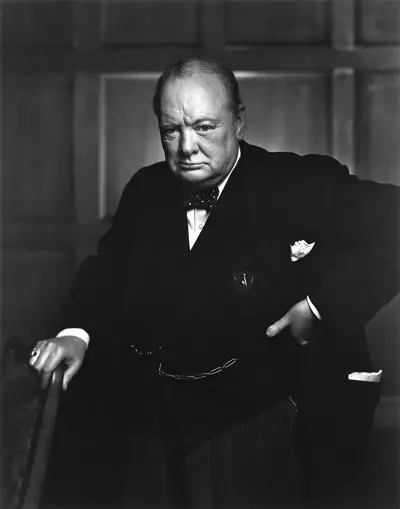
Sir Winston Leonard Spencer Churchill, KG, OM, CH, TD, DL, FRS, RA was the Prime Minister of the United Kingdom from 1940 to 1945, during the Second World War, and again from 1951 to 1955. Apart from two years between 1922 and 1924, Churchill was a Member of Parliament (MP) from 1900 to 1964 and represented a total of five constituencies. Ideologically an economic liberal and imperialist, he was for most of his career a member of the Conservative Party, as leader from 1940 to 1955. He was a member of the Liberal Party from 1904 to 1924. Churchill was also well known for his military career and as a historian, painter and writer, and among his many awards was the Nobel Prize in Literature.
