Varina Davis Quotes
I thought his genius was military, but that as a party manager, he would not succeed. He did not know the arts of the politician and would not practice them if understood, and he did know those of war.
Of her husband, Jefferson Davis, President of the Confederate States of America:
Varina Howell Davis, 1826-1906, Confederate First Lady, Jefferson Davis ... A Memoir, II, 1890
Sourced by: Eigen's Political and Historical Quotations


1st Baron Verulam. While most agree with the importance of this principle, it is easy to say and very hard to do. Appointing or electing leaders for wartime situations has always been difficult as it involves predicting how people will behave in the future. In WWII for example, many American and German Generals were fired. Adolf Hitler was the classic example of a very popular politician and demagogue who did not have a steady hand but whose maniacal lurches actually weakened the German military effort despite the morale contribution his popularity made.

She was selected by the students to give the graduating senior's commencement address


He lost the vote on this issue, and the Congress created the first committee to investigate and oversee military affairs.


Clark was particularly brilliant in the Serbian War, where he led America and NATO to a major victory without a single American being killed. There had never been a major war like it, where air power and negotiating carried the victory. And yet, that strategy was not very useful for Iraq and Afghanistan Wars. See {597899} for another of his quotations in this theme.

The Emperor was writing to his son to explain the defeat of Japan. In what was a bit of revisionist history, the Emperor neglected to mention that with the exception of some of the incursions in China, Hirohito had personally approved every Japanese invasion including Pearl Harbor. Further, it was he who had approved the orders that Japanese troops should fight to the death rather than retreat or surrender.

3 years later he led America on a huge invasion and nation building project in Iraq. It turned out that had he listened to his own advice and not flip-flopped, the huge cost of the Iraq War might have been avoided.


This issue of who has the wisdom and competency to determine policy in matters of war has been a constant one in most societies. Even in the Iraq war of the early 21st century, the Congress and the President argued as to what competence the Congress had to determine policy, strategy and tactics.
Clark had commanded the American and NATO forces in the Serbian War where all the military and political objectives were accomplished with heavy losses to the Serbian’s and none to the allied side—what many think was the most successful war in American History. Like Eisenhower in WWII one great challenge was the political and strategic one of keeping the coalition of all the allied governments working together. His perspective had been like Eisenhower and other officers in history was much wider and geopolitical than most military officers.


Most people are surprised that Lee suggested his being replaced when his army lacked military success. Strategically, he had a hopeless task. The incompetence of General McClellan and other Union Generals is the only reason that the war lasted as long as it did. However, Lee got about as much as any military commander could have given the greater manpower, industrial production, communications and transportation of the Union to say nothing of the much superior technology.


Although the two men differed on a very important issue, each admired the other and acquitted themselves politely throughout. Congress explicitly gave the President the powers that he had exercised and won the dispute. But Dixon had also won, and upheld the law as it existed until it was changed.


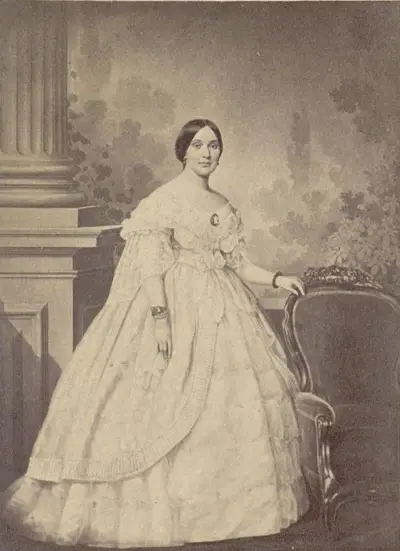
Varina Anne Banks Howell Davis was the only First Lady of the Confederate States of America, and the longtime second wife of President Jefferson Davis. She moved to the Presidential Mansion in Richmond, Virginia, in mid-1861, and lived there for the remainder of the American Civil War. Born and raised in the South and educated in Philadelphia, she had family on both sides of the conflict and unconventional views for a woman in her public role. She did not support the Confederacy's position on slavery and states' rights, and was ambivalent about the war.
