Preet Bharara Quotes
I spoke bluntly about what I had seen in a little over a year as United States Attorney for the Southern District of New York. To the apparent surprise of many in the room, I observed publicly that insider trading appeared to be rampant.
Bharara, Preet. Doing Justice: A Prosecutor's Thoughts on Crime, Punishment, and the Rule of Law. Knopf, 2019.


Barry Bonds was a star professional baseball player whose accomplishments were aided by taking illegal drugs. He lied about his use of drugs, and the Department made a very large effort over years to finally prosecute him. However during that time there were almost no prosecutions of the thousands of bankers and financiers who had lied, cheated, forged legal documents and in the process almost permanently ruined the American economy—the Great Recession of 2008. The Justice Department claimed that white collar cases are very complex and take longer to prepare prosecutions. Critics claimed that there are so many law breakers, that the government does not want to prosecute all the felons, but just go after a few, and this is easier if time has gone by and public anger has receded or been forgotten.


The then attorney general had begun a series of investigation which discovered that most of the major Wall Street brokerage houses were engaged in systematic frauds to cheat small investors. One dramatic fraud he uncovered was that the research expert analysts of major firms would recommend the stock of businesses that their firm was doing investment banking for even when they knew that the companies were not doing well or were even in deep financial trouble. See {627544}.


4 weeks later Lance resigned as Budget Director over ethical lapses.

At the fall of the Soviet Union, the sell off of much of the state assets to private enterprise fell into the control of a few, so called oligarchs. Many of these looted the enterprises that they controlled. None the less, they were considered leading citizens and many were politicians.
Actually a few minor characters were prosecuted for financial crimes committed during that period but none were prosecuted whose behavior caused or accelerated the meltdown, and no bank officers were prosecuted despite the FBI reporting that hundreds of thousands of Mortgage Foreclosure involved perjury by bank officers in a pattern that was used by most of the large major banks. The Obama administration was in the dilemma of either choosing one or two bank officers of whom to make an example or if all those who had committed serious crimes were prosecutors, it would involve thousands of the officers of almost every major bank and tens of thousands of officials and mortgage related firms. These were among the wealthiest and most influential people in the country, and there would be few left to build the American Banking System back up when that was one of our most important national priorities. They were also amongst the largest political contributors to both political parties. So the government bailed the bankers out financially, allowed them to maintain million dollar of more salaries and bonuses, and gave the entire batch of people who broke the law a de facto immunity from criminal prosecution. A further complicating factor was that many of the most egregious, greedy, and publicly harmful were not illegal as a result of much change in the law as a part of financial deregulation or were new schemes that the financial industry had successfully lobbied to prevent regulation as with Derivatives.

In the economic meltdown of 2008 and the aftermath, there were so many criminal violations of law in the financial industry that even the Democratic administration of Barack Obama chose not to jail the violators but to levy some large token fines albeit ones which were very affordable for the institutions who had to pay them—in many cases paying them with money made as a result of profits on no-interest money they received in bailouts after the 2008 Meltdown.

Greenspan and some others assumed that the shareholders and the executives who ran the financial institutions had the same vested interests. But the executives had disconnected themselves from the fate of the shareholders, by having Golden Parachutes to protect the executives even if the business failed and they were fired. And they got their bonuses immediately so by the time the authorities and the shareholders discovered that the profits the bonuses were paid for were illusory, the bonus money was safely stored in a secret offshore bank. But if things went wrong, there was always the play of getting a government bailout which would keep the executives getting their huge bonuses and keep the shareholders from losing their money as the taxpayers covered most of the losses.

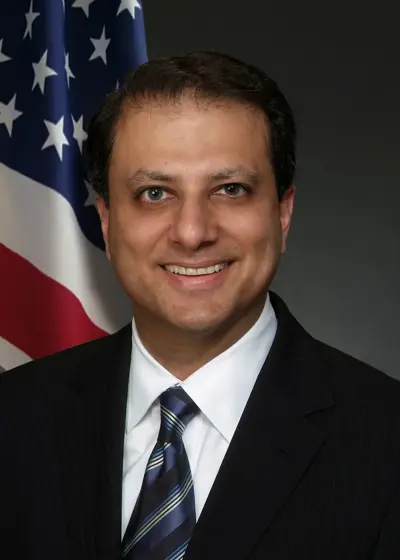
Preetinder Singh Bharara is an American lawyer, author, and former federal prosecutor who served as the United States Attorney for the Southern District of New York from 2009 to 2017. He served as an Assistant U.S. Attorney for five years prior to leading the Southern District. According to The New York Times, Bharara was one of the "nation's most aggressive and outspoken prosecutors of public corruption and Wall Street crime" during his tenure.
