Mark Twain Quotes
...I never can think of Judas Iscariot without losing my temper. To my mind Judas Iscariot was nothing but a low, mean, premature, Congressman.
Samuel Langhorne Clemens, 1835-1910
Mark Twain, Writer, Founder, Anti-Imperialist League, "Foster's Case," New York Tribune, March 10, 1873
Sourced by: Eigen's Political and Historical Quotations


Clay came from the western part of Kentucky—then the "western" part of the United States.


President Clinton had engaged in sex with an intern in the Oval Office and lied about it in investigations. Clinton had been an embarrassment anathema to the Republicans by producing a remarkably strong economy without cutting taxes, reducing government deficits, cutting the size of government, winning the Serbian war without a single American soldier dying, and preempting many of their programs. So the Republicans who controlled both Houses of Congress decided to impeach Clinton for the lies. Wexler argued that there was no damage done to the nation and the sex and lying did not rise to the required level of an impeachable offense. On a party line vote, Clinton was impeached, but the Republicans could not even get the majority of the Senate which they controlled. Most senators agreed with Wexler. See {583801} for a later summary of the absurdity of impeaching Clinton who left office as one of the most popular presidents in modern times.

Referring to political columnist Drew Pearson:

The Slavery issue was so contentious that many Northern Congressmen had just given up on the abolitionist cause or never agreed with it even though in many areas of the country the majority of their constituents supported abolition.


Treason has often been committed by those must trusted in a nation.

Kerry had just finished a formal presentation, and thought that the microphones he was wearing had all been removed. Some opponents accuse him of knowing that he was overheard by live mikes.


He was one of the Black intellectuals who criticized the white’s favorite Negro Leader, Booker T. Washington who concentrated his efforts on Black education and self-improvement to make Blacks more acceptable to whites. Trotter was the first man of color to earn a Phi Beta Kappa key from Harvard University. He was an outspoken critic of President Woodrow Wilson’s policy that for the first time instituted official segregation of Federal Employment and his firing of all Blacks then in executive or white collar positions in the Federal Government. Wilson, for all his supposed modernity, was one of the most racist of all American Presidents. Washington thought that segregation was so entrenched that it would take many generations to eliminate it, and therefore felt that the best thing to do was to improve the positions of Blacks within the segregationist structure. Both sides were right from different perspectives although Trotter, Dubois and their followers did much more to confront and eventually change racist America.


Paine had been imprisoned in France for his political writings. After inspiring the nation in the Revolution, he was not a very popular figure in America, being regarded as an atheistic, rabble-rouser. The President distanced himself from the situation and did nothing to secure Payne's release.


McCarthy was one of the most interesting political phenomena of politics in the 1950s. He was an alcoholic megalomaniac who made wild accusations about communists everywhere and that the Secretary of State and other politicians were communists. He claimed to have a list of thousands of communists in high positions of government. His accusations were so dramatic that most people assumed that there were facts behind them otherwise no rational man would say such things. But it turned out that not a single accusation was ever proven. When McCarthy was esposed, he was censured by the Senate and he lost most of his political credibility and shortly thereafter died as a result of his severe alcoholism.

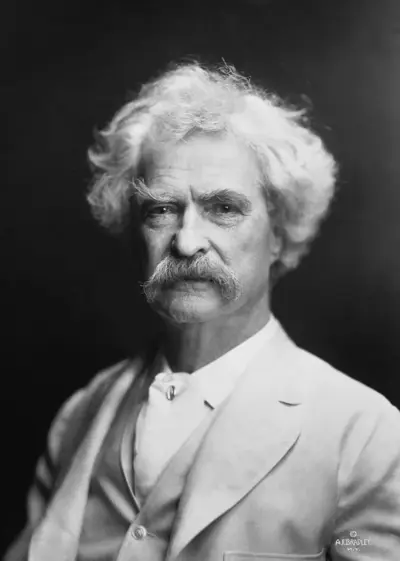
Samuel Langhorne Clemens, known by his pen name Mark Twain, was an American writer, humorist, entrepreneur, publisher, and lecturer. He was lauded as the "greatest humorist the United States has produced," and William Faulkner called him "the father of American literature". His novels include The Adventures of Tom Sawyer (1876) and its sequel, the Adventures of Huckleberry Finn (1884), the latter often called "The Great American Novel".
