Muhammad Ali Jinnah Quotes
I know there are people who do not quite agree with the division of India and the partition of the Punjab and Bengal. Much has been said against it, but now that it has been accepted, it is the duty of every one of us to loyally abide by it and honourably act according to the agreement which is now final and binding on all.
Jinnah, Muhammad Ali. Quaid-i-Azam Mohammad Ali Jinnah: Speeches and Statements as Governor-General of Pakistan, 1947-1948. Government of Pakistan, Ministry of Information and Broadcasting, 1989, p. 46.

He was echoing proposals that he made in the Delhi Emergency Committee that had been called to cope with the butchery and murder when the Hindus and Sikhs were trying to leave the areas that were to be part of Pakistan under the Partition and the retaliations against the Delhi Muslims who were trying to flee to the new Pakistan. Unfortunately, the Muslim leadership did not want such a truce as while the land had been partitioned, Indian Money, military equipment, and other resources were yet to be divided and the Muslim leaders who had been so successful playing the violence card to gain and independent Pakistan, did not want to give up that option in the remainder of the division of India. Also, it was not at all clear that the Muslim political leaders could even then control the mobs who they had already whipped up to violence.


There were several difficulties in this definition even for those British and Indian Congress leaders who were willing to accede to an independent Muslim state. Two of the most important where the definition of areas. They could be so defined as to include majority Hindu or Sikh areas surrounded by larger majority Muslim areas—the classic problem of boundary districting and redistricting. This was an insurmountable problem in the Punjab and elsewhere. The 2nd was the undemocratic nature of the demand. The Muslim League, unlike the Congress Party, had never had a very large participation and its leaders were never elected over a series of free and fair elections. Many Muslims were opposed to the Muslim League and there were areas of India, like Kashmir, where a large proportion of the 70% Muslim population were opposed to partition and if there were to be one would prefer to remain with India. With virtually 100% of the Sikhs, Hindus, Buddhists and Christians of Kashmir refusing to be part of a Muslim state, the majority in Kashmir would have then voted to remain a part of India but the Muslim League did not take account of democratic processes at the time. They changed their view later after they had infiltrated tens of thousands of semi nomadic Muslim Tribesmen across the border to gain the majority. Then the Indians would not accede to a plebiscite until the newcomers were removed and India has been in a constant war with Pakistan who has been trying to gain control of Indian Kashmir by war and terrorism.

This is another example of how President Roosevelt conducted his own international diplomacy independent of his own State Department. At the time, the U. S. State Department would not have any contact with Nehru who was in and out of British Indian jails for his anti-Colonial agitating. Roosevelt, however was a great admirer of Nehru and the Congress party and the commitment to democracy, freedom of religion, speech and the press and civil rights. Roosevelt and the American military strategic leaders were beginning to worry that China, even with help, would not be able to hold off the Japanese aggression, and India would become a frontier for the Allied war effort. The President realized that Nehru and his Congress Party were pressuring England for independence and extreme Indian nationalists were advocating non-support of the British military effort and strikes and protests to bog down the British army dealing with them instead of fighting the Japanese in Burma and elsewhere. There were a large number of Indian Brigades fighting for the British and if the Indian military volunteers were to be discouraged or boycotted, the allied war effort would suffer. So the President's style was to personally see what he could contribute over and above (and often to the distress of) his agencies established to do the job.


The British Prime Minster was supporting the partition of India so there would be an independent Muslim Pakistan which India had the power to do before they granted independence, Nehru told him that this would be against the wishes of the majority Hindus of India and therefore Attlee should reconsider. But to not have a Muslim independent state would mean compelling the Muslims to be in a unified country which they opposed. So while Nehru's point was well taken, there was no way that Attlee could do anything that would not involve compulsion of at least one of the two major factions in India, and as things would turn out, both sides felt compelled and limited their cooperation with each other and the British.

Jinnah had whipped up his followers to violence so that Muslims were attacking Sikh and Hindu neighborhoods, burning them and murdering many occupants in different parts of India to intimidate the Indian Governmental Ruling Congress Party, The British Colonial Indian officials and the politicians in London to create a Muslim state—Pakistan—with all the territory that they demanded. Many Muslims were in turn killed in retaliatory attacks. The American diplomats and most English politicians tried to persuade Jinnah to compromise on the division of land and resources. Jinnah saw no reason at the time for compromise. However the internecine violence became so brutal and extensive that even Jinnah was shocked. The British would not be intimidated nor would the Indian Congress party and Jinnah was forced to compromise. Even with that, there were over 2 million Indians killed by the time the partition was complete. Jinnah and most other leaders were not willing to die themselves, but they were able to convince enough of their coreligionists to die.

This famous quotation, from this important address, at such a critical time in history has been admired for years. Despite his great oratory, the next months were to see almost 2 million Indians of all faiths killed in what was probably the worst internecine violence in human history. Ironically, the politically motivated terrorism had stopped since all the decisions had been made. The motivation for the frightful atrocities that took place from then on was vengeance and fear of more vengeance." 1st Earl Mountbatten of Burma
At Indian Independence from Britain, people could choose whether they wanted to be citizens of India or the new Muslim state created because many Muslims insisted on living in a country that was majority Muslim. However, and what came as a great shock to the then new Pakistani leadership, the majority of the Muslims of India choose not to become citizens of the new Islamic state and preferred to stay in Hindu dominated India which they knew would be democratic, free, and would protect their right to practice Islam as they saw fit. Many feared that in Pakistan Islamic extremists would dictate the exact form of Islam that Muslims must follow, and that is exactly what happened in Pakistan—not only from government action proscribing religious practice but from the government tolerating and not interfering with Islamic fundamentalist extremist terrorists who often assassinated Muslims whose particular form of worship was offensive to them or people would call for reforms of the protection of human rights.
The Partition was accompanied by over 2 million murdered Indians as India was divided into a smaller India with almost all the Hindus and Sikhs and a slight majority of the Muslims and Pakistan with all Muslims who made that choice. Pakistan has been trying to de stabilize the area ever since to gain control of more land and became a theocracy and military dictatorship—sometimes de facto and sometimes de juro.

Recipient of the National Security Medal


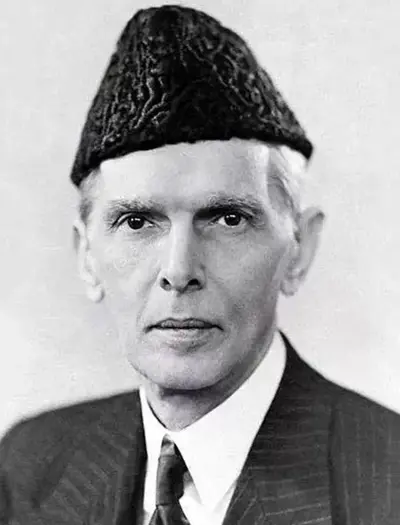
Muhammad Ali Jinnah was a barrister, politician and the founder of Pakistan. Jinnah served as the leader of the All-India Muslim League from 1913 until the inception of Pakistan on 14 August 1947, and then as the Dominion of Pakistan's first Governor-General until his death. He is revered in Pakistan as the Quaid-i-Azam ("Great Leader") and Baba-i-Qaum ("Father of the Nation"). His birthday is observed as a national holiday in Pakistan.
