Toussaint Louverture Quotes
I invite you, citizens, to open your eyes and to give serious attention to the future. Reflect on the disasters which may ensue from longer obstinacy. Submit to lawful authority, if you wish to preserve the South untouched. Save your families and your property.
Beard, John R. The Life of Toussaint L'Ouverture, the Negro Patriot of Hayti. Ingram, Cooke, and Co., 1853, p. 129.


Providence, a large shipping center, not only shipped Southern Cotton, but was the home port of some of the major slave traders who brought and sold slaves to the South.
When the first Southern States seceded, each appointed a whose job it was to persuade the other Southern States to also secede. In this case Hale was marketing secession to Kentucky which with Maryland were the only two Southern States to reject what they regarded as treason and rebellion. The importance of the quotation however is in his argument which was all based on enmity to racial equality and abolition. Later Southern apologists would argue that the Civil War was fought, not about slavery and racism butt about different philosophies of government. See {623715} .

Many historians argue that at this point the Confederacy was beaten and had they then surrendered everyone would have been much better off. But Davis and other Southern leaders, with their ideological and twisted moral logic dragged the war on for two more years and much of the South was destroyed making things even harder for the Southerners during Reconstruction.


Butler was at the time the Union general in charge of Louisiana. He had on his hand a large group of slaves whose owners had abandoned the area. There was no emancipation yet. He wrote for instructions. The result was the first actual emancipation of slaves.

He had no authority to do this. He just took it upon himself. This was one of the incidents which caused later Congresses to pass very strict laws limiting the authority of all Federal Military and other intelligence and police forces so that they have little or no authority within the United States. President Lincoln did not allow the order to stand, although he repudiated it very delicately and as privately as possible. Many in his own party strongly favored this proclamation as it cracked down on the Southern Rebels and emancipated slaves—both objectives of many Republicans. In addition, Fremont was very popular with the people and had strong political connections. (He would later run for President.) See {635739}.

The Governor was a staunch Confederate supporter but his state legislature majority favored the Union. He was forced out of the governorship when the 1861 election gave the legislature a veto-proof pro Union majority.

At this point, there had hardly been any fighting and no outrages or war crimes were yet committed by either side. These would come later—more on the Confederate side as they did not want to take the limited resources they had from their troops to fulfil abstract obligations to prisoners of war or to civilians. A few deliberately chose to use terror tactics. The Union troops also at various points in the war got out of hand and looted personal property of civilians. But at this point, this proclamation was just lies and propaganda.

Seward, the newly appointed Secretary of State was extremely concerned that if the radical direction that many of the Southern States were moving in turned into a Civil War, that the Union should not be seen as the precipitating initiator. His policy was followed and the secessionist extremists, not so politically sensitive, attacked Fort Sumter and became the initiator of the war so far as public opinion was concerned domestically and internationally. It was very important for the Union effort that the Confederates by seen as a group of radicals rebelling against the authority of a legitimate state. If that was the case, any effort to aid or help the South could be seen as an unfriendly act of war against the United States. Conversely, the South would have liked to be seen as an independent nation, no longer connected to the United States and entitled to diplomatic relations and foreign trade with all other nations. But the attack on Fort Sumter made that position much harder to maintain.

Buchanan us considered by most historians to have been the worst or one of the worst Presidents of the United States. At this point, he was a lame duck president with Abraham Lincoln, the President Elect soon to take office. This speech, just encouraged the South more than ever and helped to bring about the Civil War. His vacillation and lack of any leadership on the slavery question exacerbated the polarization that was tearing the nation apart.
It is often said that “elections have consequences”. The 1960 election was one that certainly had profound consequences. Lincoln was unwilling to force the Northern states to return fugitive slaves against the constitution, laws and will of the people of those states as Buchanan said he was (but had a hard time doing). Also Lincoln was unwilling to allow new territories to enter the union if they allowed slavery. In the end, most pro Slavery politicians realized that with the greater growth rate of the North, they Southern disproportionate power in the Congress was doomed as would be the institution of slavery itself. Crittendon a strong Unionist from a border state, understood the implication of Lincoln’s election for the Union.

The early Union military leadership was so poor and timid that it was not clearly demonstrated that a Confederacy was not viable until later in the war, and the Southerners possessed an extraordinary capacity for ignoring reality and self-delusion, that it was not demonstrated until Grant’s major victories and Sherman’s March through Georgia and the Southern East Coast that an independent South was not going to be.

As in almost every war, there were disagreements between the Confederate Generals and the civilian authorities. See {633934} for another Civil War Southern example.

And so they were. However, Calhoun had already concluded which alternatives the South would take. See {635930}


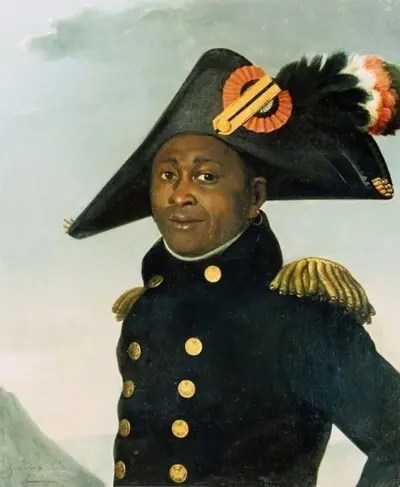
François-Dominique Toussaint Louverture was a Haitian general and the most prominent leader of the Haitian Revolution. During his life, Louverture first fought against the French, then for them, and then finally against France again for the cause of Haitian independence. As a revolutionary leader, Louverture's military and political acumen helped transform the fledgling slave rebellion into a revolutionary movement. Louverture is now known as the "Father of Haiti."
