Jefferson Davis Quotes
An enemy, waging war in a manner violative of the usage of civilized nations, has invaded our country. With presumptuous reliance on superior numbers, he has declared his purpose to reduce us to submission.... Recent disaster has spread gloom over the land, and sorrow sits at the hearthstones of our countrymen; but a people conscious of rectitude and faithfully relying on their Father in Heaven may be cast down, but cannot be dismayed.
Many historians argue that at this point the Confederacy was beaten and had they then surrendered everyone would have been much better off. But Davis and other Southern leaders, with their ideological and twisted moral logic dragged the war on for two more years and much of the South was destroyed making things even harder for the Southerners during Reconstruction.
Jefferson Davis, 1808-1889, U. S. Congressman & U. S. Senator (Democrat, MS), U. S. Secretary of War, President, Confederate States of America, May 16, 1862
Sourced by: Eigen's Political and Historical Quotations

That is the way he was killed. The phrase, “We are bound to believe that, anyhow” indicates that Stuart really realized how futile the Southern war effort would be but loyalty and patriotism required him to suspend his rational belief structure.


Committee of the Congress. This was the prevailing Congressional and public view except for the South which had coalesced around an intellectual rationalization. See {618013}.

Sherman, one of the most gifted generals of the Civil War. He hated the cruelty of war and the Civil War in particular as he had specifically warned his Southern friends ahead of time about what war would bring. See {585882}. Sherman was one of the first American military men to look at war without any of the romantic, patriotic, noble attributes that most others did.


While there were atrocities committed by both sides in the Civil War, the proportion tended to be heavily weighted by Confederate perpetrations. The Confederate officers were not appointed by the command structure and under strict military discipline, but they were elected by the troops and could be so removed (except for the general officers who were appointed by the confederacy). Also, the confederate troops were not as well fed or supplied as the North and they had fewer resources with which to fulfill their obligations to prisoners. In a number of battles, ill-clothed soldiers stripped the Union dead, wounded and prisoners, often naked to use their shoes, blankets and clothing, Union prisoners of war were much more badly abused in the prisoners of war camps like Andersonville which were not under the command of Robert E. Lee.

The historical import of this quotation is that North Carolina was unable to support its troops fighting in Virginia so they resorted to asking for private donations. In addition greedy speculators were offering inflated prices to citizens for needed military supplies and after buying them jacking the price up much higher and selling it to the state who because of the lack of productivity, the men in the field and the Union embargo had very few options to obtain needed supplies.


Confederate General Wheeler had introduced a new tactic of mining the roads with improvised explosive devices which took their toll on Sherman’s troops. At the time, this was against the ruled of war. Sherman ordered a few Confederate prisoners to the front and required them to walk ahead of his troops and demine the roads. He then allowed some of the prisoners to return to General Wheeler with a note from Sherman, explaining that if the Confederates persisted in this unethical form of warfare he would march all of the Confederate prisoners in the front of the troops and force them do remove the explosives by hand regardless of the danger. Wheeler never planted land mines again.

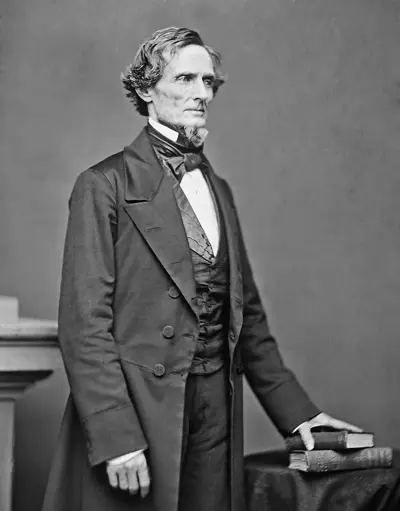
Jefferson Finis Davis was an American politician who served as the president of the Confederate States from 1861 to 1865. As a member of the Democratic Party, he represented Mississippi in the United States Senate and the House of Representatives before the American Civil War. He previously served as the United States Secretary of War from 1853 to 1857 under President Franklin Pierce.
