Arthur Wellesley, 1st Duke of Wellington Quotes
I have often heard Your Majesty say so.
1st Duke of Wellington. The King was somewhat delusional, and there is no historical records of his ever having personally fought in the Napoleonic wars at all. This quotation has often been nominated for the most tactful in history.
Arthur Wellesley, 1769-1852, British Chief General at Waterloo, Ambassador to France, Prime Minister (Tory), Response to King George IV, who at a Dinner Party claimed to have led a Calvary Charge [in disguise] against Napoleon and asked the Duke who was the commanding general to verify his statement.
Sourced by: Eigen's Political and Historical Quotations

Marquis of Lansdowne. What makes this quotation so noteworthy is the illustration of a political rarity. The leader of the country calls in a leading politician and asks for advice on a current political problem. Politicians almost always have advice to give even when it is not wanted or asked for. But the total number of occasions where the Politician had no good advice could be measured on the fingers of one hand. This is the most classic. The problem was that the previous government had collapsed for want of a majority of Parliament, and the Queen was seeking advice on which of the leading politicians she should ask to try and put a government together. However, no one was sure that any of the politicians could muster enough support to form a government, but everyone had an opinion except Lord Lansdowne.


Adultery for a queen was considered treason. Adultery per se was not punished with death in 16th century England, but the concept was that a Queen who committed adultery was risking the royal bloodline and therefore the Crown and the Nation.

“Somsteu” was the name the Africans gave to Theophilus Shepstone, 1817-1893, British Colonial African Administrator.

In the British Constitutional Monarchy of the Victorian Era, the Queen still possessed enormous power and many in Parliament was constantly trying to have Parliament assume many of the Queen’s powers. The Prime Minister was in an awkward position. On the one hand, he was the Queen’s Prime Minister and leader of HER government. At the same time he was the leader of the political party that had won the last Parliamentary election. His party was trying to usurp some of the Queen’s powers and Peel explained to the Queen’s assistant that he would generally side with the Queen against his own party. It is doubtful that Anson and the Queen believed Peel on this point as his position as Prime Minister depended not on his being elected by the voters but by his party members of Parliament. In modern times, the British monarch has few real powers but is still very influential so there are no struggles over power with Parliament.


This testimony turned out to be a tactical error. The main purpose of Tojo was to protect Emperor Hirohito from responsibility for the war. See {587277}. But by admitting that he never disobeyed even the Emperor’s wishes, he made it clear that he had implemented the Emperor’s desired policies. Therefore, Hirohito must have been responsible. After this testimony there was some delay and he changed his testimony claiming that once he disobeyed the Emperor when he took the nation to war. Few believed this second version, but it was sufficient to keep Hirohito from being charged—which despite many calls for his trial, General MacArthur also did not want the Emperor brought to account as the institution was making the occupation of Japan very easy.


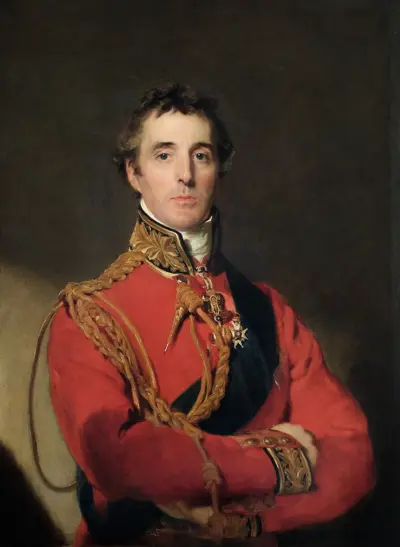
Arthur Wellesley, 1st Duke of Wellington, KG, GCB, GCH, PC, FRS was an Anglo-Irish soldier and Tory statesman who was one of the leading military and political figures of 19th-century Britain, serving twice as prime minister. He ended the Napoleonic Wars when he defeated Napoleon at the Battle of Waterloo in 1815.
