Marcus Garvey Quotes
I have no desire to take all black people back to Africa; there are blacks who are no good here and will likewise be no good there.
Garvey, Marcus. Philosophy and Opinions of Marcus Garvey. Edited by Amy Jacques Garvey, vol. 2, Universal Publishing House, 1925, p. 122.

This idea has been rejected by American Blacks from before the Civil War. There were many Black families that have been in America longer than Rockwell who always had the choice to go back to where they cam from if they were unhappy with America but they never did.


Qutb was studying at Greeley College and with some Egyptian friends want to a movie theater. Greeley, even though not in the South, practiced racial discrimination in many of their public accommodations and the Civil Rights Law would not be passed for another 15 years or so. The ticked clerk at first would not sell tickets to the dark skinned Egyptians and when one protested, the owner was called. He ruled that as long as they were not American Blacks, they could enter. But Qutb refused.

Warren a Republican from California who knew Palmer for years, stood up, put his arm around Palmer and told him, “Kyle, you and I will always be friends” and walked out.


The Turks had massacred the vast majority of their Armenian population, and treated the Greeks badly killing and them many of them from territories the Ottoman Turks had conquered. Jews fared better but were 2nd class citizens. Bristol was the American State Department’s senior official and was very “understanding” of the murders and ethnic cleansing despite the fact that President Wilson and most American politicians were very opposed to the Turkish massacres. See {620614} and {620599} . Two factors makes this quotation very significant. First, at the time the State Department was not really under the control of either the President or the Congress. It was not rare for the Department to have its own policies and implement them. This began to change in WWII and FDR exercised much more control than previous presidents since Theodore Roosevelt. The second factor is that there were many racists throughout the State Department—Bristol was only one. There was little concern for minorities’ welfare and the emphasis was on commerce. See {620600} Even in Truman’s administration, the President had massive opposition from the State Department for his policy of recognizing the State of Israel. Today, this kind of racism in the State Department is very rare, and human rights has been one of their major concerns. There were many changes in 75 years.


He was advocating separation of the races.

The Boers were lower class, uneducated, farmers from Holland who came to South Africa before the English did. They were at the bottom of the Dutch socioeconomic ladder. Unlike the English who were interest in establishing a trading colony, the Boers just wanted to own and farm the land and use blacks as slave or cheap labor. The Dutch Government and Trading companies lost interest in South Africa as there were much more profitable parts of the world, and they felt no obligation to the Boers whom they were glad to be rid of. So the Boers found themselves having to follow the British laws and rules of the British Colonial Office. Slavery was outlawed, and Blacks could be educated and become citizens under British law. They could own land, and contest the right of the Boers who had settled in some uninhabited land and some that was owned by Black tribes. The Blacks outnumbered the whites in general and the Boers, and there were educated Blacks who “outclassed” the still relatively uneducated Boers. So the Boers, fighting for their “way of life” set up their own area in Southern Africa and claimed independence. But Blacks claimed that it was their land and looked to the British to exercise English law. The Boer war ensued. Although the Boers lost the war, the bred at a much faster rate than the English, many of whom did not even have their families in South Africa. By the end of WWII, the Boer white majority controlled the government and kept the majority Blacks from voting and having full citizenship rights. They dominated Apartheid South Africa until the Black Revolutionists obtained control and although Black and white relations are better in South Africa than most countries, the extemeist Boers and most militant Blacks are in political, but not violent, conflict. Churchill and the British have always perceived themselves as being caught in the middle between the Boers and the Blacks.


The first sentence is inscribed on the Jefferson Memorial in Washington DC. The last two sentences are rarely quoted.


The upper socioeconomic classes are generally less rascist then the lower classes in the United States as well as England and South Africa. The counter argument given by the lower classes are that the upper classes have the money to insulate themselves from the negative aspects of desegregation and the lower class whites have to bear the brunt of desegregation. However, in South Africa, the English of all socioeconomic classes were far less enthusiastic about apartheid then were the Boers. The latter were farmers who wanted the land; the former were traders who could succeed even of the Blacks had their land and were given political rights.


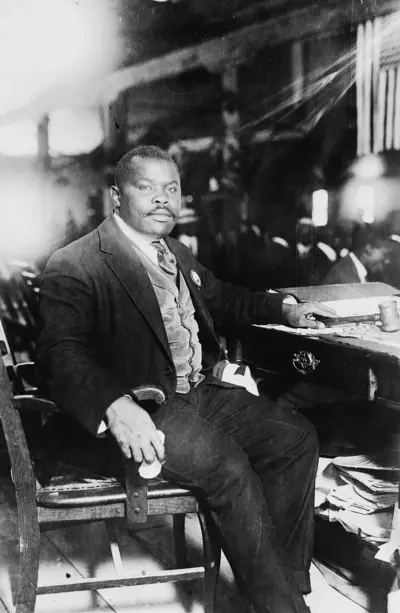
Marcus Mosiah Garvey Sr. ONH was a Jamaican political activist, publisher, journalist, entrepreneur, and orator. He was the founder and first President-General of the Universal Negro Improvement Association and African Communities League (UNIA-ACL, commonly known as UNIA), through which he declared himself Provisional President of Africa. Ideologically a black nationalist and Pan-Africanist, his ideas came to be known as Garveyism.
