Walter Kohn Quotes
I have just joined the Board of the Population Institute because I am convinced that early stabilization of the world's population is important for the attainment of this objective.
Kohn, Walter. "Walter Kohn - Biographical." Les Prix Nobel. The Nobel Prizes 1998, edited by Tore Frängsmyr, Nobel Foundation, 1999.


In Burundi, family land is divided among the male children of a family. The average Burundian woman has 6.3 children, nearly triple the international fertility rate. With this fertility rate, the plots of land for each person inevitably get smaller and smaller over time. At 10,745 square miles, Burundi is slightly smaller than the U.S. state of Maryland, but it holds nearly twice as many people: about 10 million. The small plots of land are inefficient to farm and provide subsistence. So the nation was in a crises as there was little industrialization and land was essential for existence for most Burundians. See {35808} and {35809}.


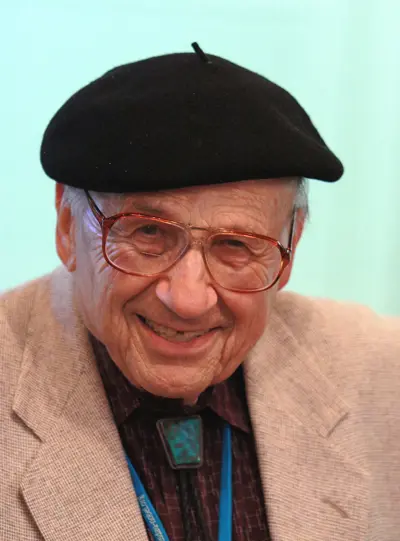
Walter Kohn was an Austrian-American theoretical physicist and theoretical chemist. He was awarded, with John Pople, the Nobel Prize in Chemistry in 1998. The award recognized their contributions to the understandings of the electronic properties of materials. In particular, Kohn played the leading role in the development of density functional theory, which made it possible to calculate quantum mechanical electronic structure by equations involving the electronic density (rather than the many-body wavefunction). This computational simplification led to more accurate calculations on complex systems as well as many new insights, and it has become an essential tool for materials science, condensed-phase physics, and the chemical physics of atoms and molecules.
