Dwight D. Eisenhower Quotes
I have full confidence in your courage and devotion to duty and skill in battle. We will accept nothing less than full Victory! Good luck! And let us beseech the blessing of Almighty God upon this great and noble undertaking.
Eisenhower, Dwight D. "Order of the Day." 6 June 1944. The Papers of Dwight David Eisenhower, edited by Alfred D. Chandler Jr. et al., vol. 3, Johns Hopkins University Press, 1970, p. 1913.


Some apologists for the Muslim Brotherhood claim that the organization is social and political and not violent or advocates of terrorism. However, quotations like this one calls clearly for the sacrifice of lives. Hamas, a recognized terrorist organization is the Palestinian Branch and Offshoot of the Muslim Brotherhood which has never repudiated any of their terrorist murders and actively raises money for Hamas. See the original founding principle of the Muslim Brotherhood—{621776}

That is the way he was killed. The phrase, “We are bound to believe that, anyhow” indicates that Stuart really realized how futile the Southern war effort would be but loyalty and patriotism required him to suspend his rational belief structure.

A Federal Naval flotilla was preparing to attack South Carolina Forts Beauregard and Walker in the area of Hilton Head and Port Royal. The navy took both forts the next day with their naval bombardment so powerful that the Confederate Rebels had to abandon both forts gaining a kind of revenge for the Confederate capture of Fort Sumter at the war’s beginning.


He was leading the Gordon Highlanders of the British Army against the Boers during the Boer War. He was seriously wounded and could not go on himself with a charge he had ordered, However, waifing his sword he made this famous qutation. Particualrly noteorthy is the derrogatory terms which he used to describe the enemy--the Boers of South Africa. In many wars and cultures, one or more of the combatants, in order to overcome the avarage soldier's reluctance to kill an enemy, characterizes them as less than human. In this case, vermin, who were to be exterminated. There were two predominant groups of whites who came to South Africa, the English who were generally well-educated and were interested in trading with the exhisting inhabitants and investing in businesses using mostly native labot and the Boers. The latter were of Dutch and German origin, poor farmers with little or no land in the home country and little education. Their interest was to create a nation where they could own land to farm. And the lest expensive way for them to increase their farmland was to sieze it from the native Blacks and who were the major forces behind the racial discrimination which became apartheid. The British contolled the government and sought stability and as in most of the British Empire, they wanted English law to prevail including the rights of the Black natives. The Boers had left Europe for good and would thrive or not in Southern Africa. Proportiopnately, the English might have a career in South Africa or serve there for a few years. They were Englishmen in a foreign country. The Boers saw themselves as citizens of Southern Africa who were fighting the native Blacks for control of the land. The English legal system would not allow any of the land seizures and political discrimination that the Boers saw as existential for their survival in Africa. Soon, the Boers took more and more of the law into their own hands and saw English rule and dmination as inimical to their interests in Africa and they tried to create their own independent states in Southern Africa. That was the essense of the Boer Wars. Dick-Cunyngham was awarded the Victoria Cross, the highest military decoration of Great Britain, for his exploits in the Afghan War.


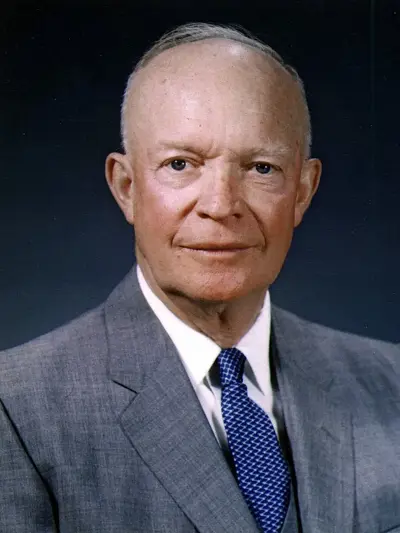
Dwight David "Ike" Eisenhower GCB OM GCS CCLH KC NPk was an American military officer and statesman who served as the 34th president of the United States from 1953 to 1961. During World War II, he became a five-star general in the Army and served as Supreme Commander of the Allied Expeditionary Force in Europe. He was responsible for planning and supervising the invasion of North Africa in Operation Torch in 1942–43 and the successful invasion of Normandy in 1944–45 from the Western Front.
