Galileo Galilei Quotes
I have been judged vehemently suspect of heresy, that is, of having held and believed that the sun in the centre of the universe and immoveable, and that the earth is not at the center of same, and that it does move. Wishing however, to remove from the minds of your Eminences and all faithful Christians this vehement suspicion reasonably conceived against me, I abjure with a sincere heart and unfeigned faith, I curse and detest the said errors and heresies, and generally all and every error, heresy, and sect contrary to the Holy Catholic Church. (Quoted in Shea and Artigas 194)
Galilei, Galileo. "The Abjuration." 22 June 1633. The Galileo Affair: A Documentary History, edited and translated by Maurice A. Finocchiaro, University of California Press, 1989, p. 292.


One irony of this statement and the belief of so many Muslims today is that in the Dark Ages when the rest of the world believed the Earth was flat, Muslim scientists and students commonly used globes to study the Earth and the Muslims preserved what was known of science.


The Roman Catholic Church had stultified scientific thinking for over a thousand years where differing with accepted church doctrine was not only discouraged but was dangerous. Even though Hicletas—see {590328}—realized that the earth rotated around its own axis three centuries before Christ, and his view was in the literature to which learned people had access, even in 1543 Copernicus had to tread lightly with the church. He enlisted the aid of the Pope to “response block” the opposition of other church authorities. Galileo later did not play politics and had a more narrow minded Pope and Vatican to contend with, and as the world knows, came into unfortunate conflict with the Church.


While the Visigoths had some very advanced legal principles, this law, quoted in its entirety is typical of the nations that were part of the Catholic world. The church and its doctrines were immune from any possible criticism, explicit or implicit. This is the most formalized and sophisticated compendium of laws of the so-called “barbaric peoples” of Europe. The compilation was in many ways a documentation of the traditional laws of the Visigoths that had evolved over hundreds of years.
Galileo was forced, under the threat of torture, imprisonment and death, to recant his scientific observations and conclusions. This historical quotation is extremely important for two reasons. First, it demonstrates the terrible effect that ideologically, rigid, religious institutions can have by corrupting scientific thinking and modernization. Second, this particular confession, and the circumstances surrounding it, were well known to the American Founding Fathers, and was one of the motivations to create the first Amendment and prevent any church’s ability to exercise this kind of tyranny over the minds of Americans. Ironically, in modern times it served as an example for the Roman Catholic Church of what to avoid in a world of constant scientific discovery, and this church has been particularly open to new science and has found very creative ways of avoiding doctrinal conflicts with modern science.

The Church exercised the law enforcement and censorship authority in all Catholic countries. Note the offense of saying anything which is “offensive to pious ears”. The particular example that “offended” the pious was that a heretic should not be executed. These were the cultural values of the day.


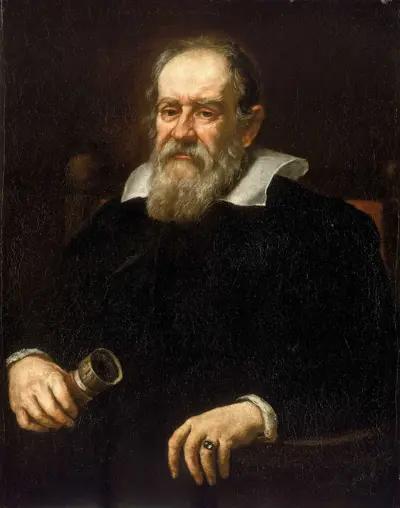
Galileo di Vincenzo Bonaiuti de' Galilei was an Italian astronomer, physicist and engineer, sometimes described as a polymath, from Pisa. Galileo has been called the "father of observational astronomy", the "father of modern physics", the "father of the scientific method", and the "father of modern science".
