Arthur Conan Doyle Quotes
What the deuce is it to me?" he interrupted impatiently: "you say that we go round the sun. If we went round the moon it would not make a pennyworth of difference to me or to my work.
Doyle, Arthur Conan. A Study in Scarlet. Ward, Lock & Co., 1888, p. 20.

The Roman Catholic Church had stultified scientific thinking for over a thousand years where differing with accepted church doctrine was not only discouraged but was dangerous. Hicletas—see {590328}—realized that the earth rotated around its own axis three centuries before Christ, and his view was in the literature to which learned people had access. Copernicus later communicated this idea to the Pope but in much more delicate terms—see {590327}. He did not have the problems that Galileo endured with the Church for several reasons. There were different men controlling the church, the printing press had been invented and Galileo published a book that many could read, the Protestant Reformation had really frightened the Church fathers who felt more vulnerable and less tolerant.


Note that Da Vinci predated Galileo. One big difference was that Da Vinci did not publish his heretical views, but wrote them in his private notebook. The church authorities likely did not know about his heresy.

The Roman Catholic Church had stultified scientific thinking for over a thousand years where differing with accepted church doctrine was not only discouraged but was dangerous. Even though Hicletas—see {590328}—realized that the earth rotated around its own axis three centuries before Christ, and his view was in the literature to which learned people had access, even in 1543 Copernicus had to tread lightly with the church. He enlisted the aid of the Pope to “response block” the opposition of other church authorities. Galileo later did not play politics and had a more narrow minded Pope and Vatican to contend with, and as the world knows, came into unfortunate conflict with the Church.


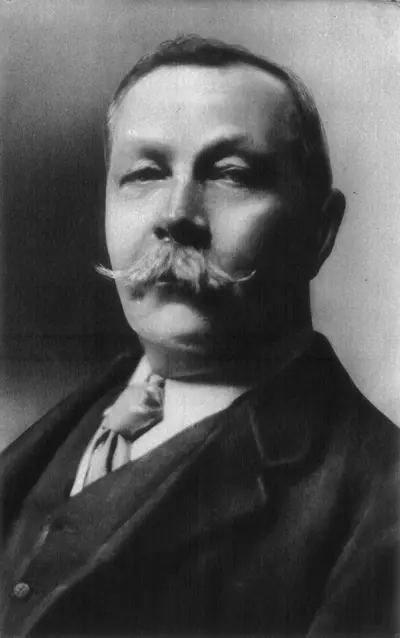
Sir Arthur Ignatius Conan Doyle KStJ DL was a British writer and physician. He created the character Sherlock Holmes in 1887 for A Study in Scarlet, the first of four novels and fifty-six short stories about Holmes and Dr. Watson. The Sherlock Holmes stories are considered milestones in the field of crime fiction.
