Heinrich Heine Quotes
I have a great fear of the atrociousness of proletarian rule.
Ironically, it was a German democracy that later elected Adolf Hitler.
Heinrich Heine, 1797-1856, German Writer & Critic, Letter to Gustov Kolb, 1841
Sourced by: Eigen's Political and Historical Quotations


This was published after he died.


And as the leader of the exploited, after his revolution he became a dictator himself, albeit a very popular one amongst most Cubans.


The Second World War placed German Communists in a dilemma. The capitalistic democracies had been an enemy of communism, but the worst enemy was Fascism and there was nothing worse than German Fascism who victimized the German communists. Therefore, the democracies were not to be regarded as the enemy of German or world communism.

There were many British and American capitalists, like Lindbergh, who were great admirers of Hitler and Mussolini and supported the Fascists.


1st Baron Macaulay


He was warning that the corporations and monopolies were taking advantage of the poor who, if there is not some balance of redress and justice will resort to violence such as the man who just short him. He gave the speech still bleeding with the bullet lodged in his body. He refused to go to a hospital or get medical care until he had finished his speech. See {633076}.


Dean had lived through the horrors of the Nixon Administration, so this was a very serious accusation from a Republican no less. By the end of the George W. Bush presidency, there were many Republicans who had repudiated Bush.
Louis Napoleon had seized control of France and had very little popular support amongst the aristocracy and middle class. However, the Socialists leading the uprisings frightened them more than Louis Napoleon as the Socialists had the support of the peasants who resented the abuses of the aristocracy and many of the middle class. This was true class warfare and not at all what was possible in the United States when American conservatives would claim “class warfare” when there was a move for more progressive taxation. In Europe, class warfare really meant death and destruction, so for many who knew the history, the claim of “class warfare” was frightening and a large part of the “Red Scare” in the United States.
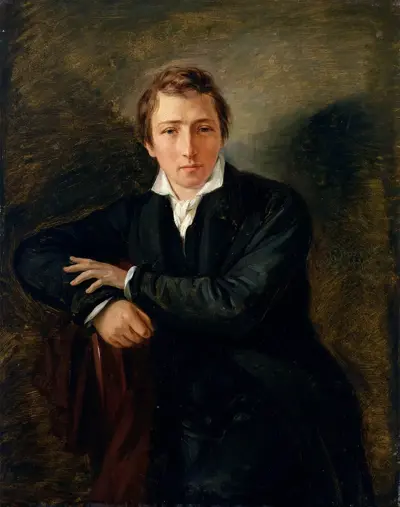
Christian Johann Heinrich Heine was a German poet, writer and literary critic. He is best known outside Germany for his early lyric poetry, which was set to music in the form of lieder (art songs) by composers such as Robert Schumann and Franz Schubert. Heine's later verse and prose are distinguished by their satirical wit and irony. He is considered part of the Young Germany movement. His radical political views led to many of his works being banned by German authorities—which, however, only added to his fame. He spent the last 25 years of his life as an expatriate in Paris.
