Augustus Quotes
I had a good mind to discontinue permanently the supply of grain to the city, reliance on which had discouraged Italian agriculture, but refrained because some politician would be bound one day to revive the dole as a means of ingratiating himself with the people.
Suetonius. The Twelve Caesars. Translated by Robert Graves, Penguin Books, 1957, p. 74.

For many nations, it is an important objective to be totally self-sufficient in their food supply—so that they would not have to depend in other nations in what might be a world famine or food supply. For those nations agricultural subsidies are useful if their farmers cannot produce as cheaply and efficiently as other nations do. In the United States, with the most efficient agriculture in the world, subsidies are a waste of public money {633243} and the result of lobbying and special interest pressure and or corruption {633245}.


What happened is that farmers over the year became either industrialized mechanized agricultural enterprises or peasants and the later did exactly what Capper predicted—moved to the cities. Agribusiness thrived and small traditional farmers were ruined unless they adopted the new technologies.

Historically, this quotation shows the desperate condition of the 1863 food supply in the Confederacy. The most profitable crops were cotton and tobacco. However, Davis and other Southern leaders had to urge patriotic Southerners to abandon those crops in favor of foodstuffs and fodder for the military and their horses. Some did but many did not.

Britain, in order to protect the landed gentry and aristocracy who made their money via agriculture, long had the Corn Laws (Corn was the term for wheat.) which was a protectionist system making it virtually to import food grains, rice or potatoes into Britain. However, with the growth of the population and a protected agricultural industry that had no drive to be more productive there was not quite enough food in the kingdom. When there was a potato blight in Ireland, the situation reached critical proportions. Victoria was not generally in favor of protectionism, and given the shortage and high cost of food then, she wanted to allow food imports. Robert Peel presided over a government where the protectionists who represented the large landowners had a very strong block. Pushing for an end to the Corn Laws could have caused the government to collapse. Peel himself did not think the Corn Laws were good policy and created a hardship for most people especially the poor. But he was the leader of his party and the party was split on the Corn Law issue. Victoria, in this private letter, tells him to do what he things is right and not what is politically expedient. Peel tried but at this time could not get a majority to repeal the Corn Laws, and the Irish Potato Famine killed millions. See {630738} . Peel however stuck with the Queen’s and his perception of what was right. The following year he proposed the Importation Act 1846 which repealed the Corn Laws. Many of his own party would not support it, but this time, he went to the two opposition parties and created a slim majority which passed the bill much to the approval of the Queen.
While this was somewhat hyperbolic at the time, it became true during the century.


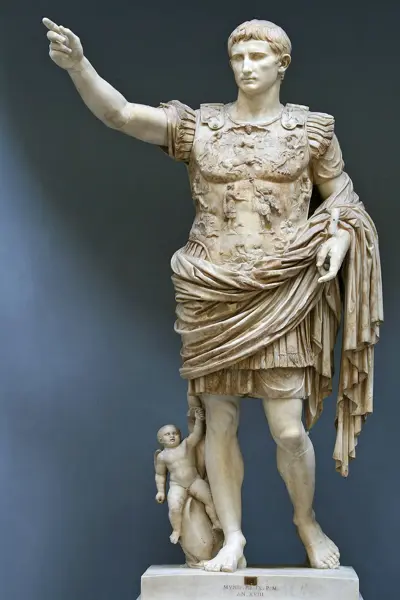
Caesar Augustus was the first Roman emperor, reigning from 27 BC until his death in AD 14. His status as the founder of the Roman Principate (the first phase of the Roman Empire) has consolidated an enduring legacy as one of the most effective and controversial leaders in human history. The reign of Augustus initiated an era of relative peace known as the Pax Romana. The Roman world was largely free from large-scale conflict for more than two centuries, despite continuous wars of imperial expansion on the Empire's frontiers and the year-long civil war known as the "Year of the Four Emperors" over the imperial succession.
