Albert Einstein Quotes
I first discovered the Jewish People in America. I have seen any number of Jews, but the Jewish People I never met in Berlin or elsewhere in Germany. This Jewish People that I found in America came from … Eastern Europe generally. These men and women still retain a healthy ethnic feeling. It has not yet been destroyed by the process of atomization and dispersion.
He and almost all of the Jews in Germany were expected to act like Germans. There was no room for maintaining and developing their own ethnic customs and traditions. When he arrived at New York, he was treated as a great celebrity by Mayor La Guardia, who was fluent in Yiddish, and other dignitaries some of whom were Jews and even met President Warren G. Harding. He lectured at City College and for the first time in his life saw Jews who had any distinguishing culture and customs—and the informality, egalitarianism, gregarious, free speaking, fun loving was just the opposite of the norms that he had grown up with in Germany which he did not like. See {640911}. He would later become a part of that culture and be seen as a leader, even being offered the Presidency of the new state of Israel in 1949.
Albert Einstein, 1879-1955, Nobel laureate in Physics, Description of his first American trip--to New York City in 1921
Sourced by: Eigen's Political and Historical Quotations

Germany before Hitler was a very narrow, formal, rigid, militaristic, class conscious, authoritarian, society.

Similar formal opposition to Jewish parochial schools was more formally voiced later—see American Council for Judaism.


Most immigration reformers want to open immigration more widely. Ward wanted immigration restricted to certain ethnicities and limited. He wanted a uniformity of assimilation and not diversity.


He was distraught at the persecution his family was forced to endure in Germany.


The Turks had massacred the vast majority of their Armenian population, and treated the Greeks badly killing and them many of them from territories the Ottoman Turks had conquered. Jews fared better but were 2nd class citizens. Bristol was the American State Department’s senior official and was very “understanding” of the murders and ethnic cleansing despite the fact that President Wilson and most American politicians were very opposed to the Turkish massacres. See {620614} and {620599} . Two factors makes this quotation very significant. First, at the time the State Department was not really under the control of either the President or the Congress. It was not rare for the Department to have its own policies and implement them. This began to change in WWII and FDR exercised much more control than previous presidents since Theodore Roosevelt. The second factor is that there were many racists throughout the State Department—Bristol was only one. There was little concern for minorities’ welfare and the emphasis was on commerce. See {620600} Even in Truman’s administration, the President had massive opposition from the State Department for his policy of recognizing the State of Israel. Today, this kind of racism in the State Department is very rare, and human rights has been one of their major concerns. There were many changes in 75 years.

Disraeli was attacked for being Jewish: 1st Earl of Beaconsfield


This is a very instructional political quotation. It shows us that the popular American narrative of the ideal immigrant who assimilated to everything American was false even in 1916. Almost 100 years later, anti-immigration advocates would complain that the modern immigrant was not totally assimilating as immigrants did in the past. Of course they never did in the past totally assimilate. The assimilation has generally been in the areas of desire for freedom and individual opportunity, democracy, rule of law, human dignity and respect for others. However, immigrants have always brought new customs, foods, literature, modes of worship, language, and values from the “old country”. Bourne was one of the first writers with a national audience to question the classic but never real “melting pot” theory of immigration and suggest the “salad” model though he never used the term.

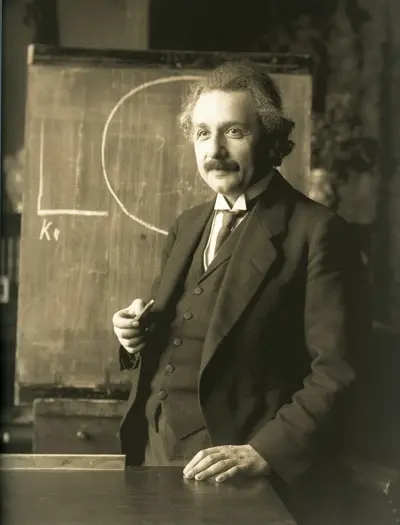
- Born: March 14, 1879
- Died: April 18, 1955
- Nationality: German, Swiss, American
- Profession: Physicist
Albert Einstein was a German-born theoretical physicist, widely acknowledged to be one of the greatest physicists of all time. Einstein is known for developing the theory of relativity, but he also made important contributions to the development of the theory of quantum mechanics. Relativity and quantum mechanics are together the two pillars of modern physics. His mass–energy equivalence formula E = mc2, which arises from relativity theory, has been dubbed "the world's most famous equation". His work is also known for its influence on the philosophy of science. He received the 1921 Nobel Prize in Physics "for his services to theoretical physics, and especially for his discovery of the law of the photoelectric effect", a pivotal step in the development of quantum theory. His intellectual achievements and originality resulted in "Einstein" becoming synonymous with "genius".
