Michael Hayden Quotes
I don’t see the excesses.
The nation was in the midst of a national scandal when it was revealed that the National Security Agency was wiretapping and hacking into all telephone calls, e-mails, and other files for every single American. Hayden was typical of many in the intelligence agencies who didn’t even recognize that this was excessive as most Americans thought. The disconnect was at the heart of the problem which the nation was debating. Hayden’s argument was that the collecting of everyone’s private communications data was not an excess; what would be an excess is the abuse of how that data was used by the intelligence agencies which he claimed that other than some administrative errors had not taken place. Most people thought that the hacking and wiretapping without a warrant violated the 4th Amendment to the Constitution even if none of the data were kept permanently. However, the NSA was keeping all the meta data—the person, date, person called or e-mailed, the location of the communication sender and receiver, the time, and the length of the communication and analyzing it constantly tracking the networks of who each American communicated with. Hayden and other intelligence officials, including the President, claimed that the government was not reading (or listening to) the actual text of the messages and conversations without a warrant. However, those same officials had denied that they were collecting anything on large numbers of Americans and they deliberately lied about this even to the Congressional oversight committees. It took a major leak to disclose the truth. Many thought that even the claim of the minimum usage might also be a lie. The record demonstrated that intelligence officials had frequently lied to the President so even his statement was in question. Additional leaks also showed that the intelligence agencies had lied to the FISA courts to get warrants. Critics asked if collecting information on every single phone call and e-mail and internet communication was not excessive, what could possibly be excessive.
Michael Hayden, Air Force General, Director, CIA, Director, National Security Agency, Interview, NBC Meet the Press, December 15, 2013
Sourced by: Eigen's Political and Historical Quotations


He was the Chairman of the Senate Judiciary Committee. The NSA had hacked into the servers of these firms and others that were located out of the country. (They would need to have a warrant if inside the country.) The companies had never known it until Edward Snowden made this practice public. The result was, the public was learning that there was no privacy in any of their e-mail, social media activity, exchange of photos or videos or anything else. The companies feared that this would then harm their business, and that the techniques NSA used to hack there servers would then be discovered and used by others to steal identities, credit cards and do such other damage to customers. Even if the particular hacking methods were not leaked to the bad guys, they, knowing that the servers were vulnerable, would be encouraged to work to figure it out.
Snowden, was a contract worker for Booz Allan assigned to the National Security Agency (NSA). He felt that some of the NSA activities were illegal and unethical and tried to complain to NSA officials who rebuffed him. Despite the fact that he had signed an agreement not to do so, he copied many critical, classified documents that exposed much of the NSA activities that the NSA officials had denied existed—including lying under oath to the Senate. He then made many of them public, violating his oath, breaking the law, and opening up an entire area of government spying which most Americans knew nothing about and about which senior government officials had lied under oath to Congress. They of course wanted to prosecute Snowden who had told the truth, while they had lied. For many Americans, this became a moral and ethical conundrum.
Snowden, was a contract worker for Booz Allan assigned to the National Security Agency (NSA). He felt that some of the NSA activities were illegal and unethical and tried to complain to NSA officials who rebuffed him. Despite the fact that he had signed an agreement not to do so, he copied many critical, classified documents that exposed much of the NSA activities that the NSA officials had denied existed—including lying under oath to the Senate. He then made many of them public, violating his oath, breaking the law, and opening up an entire area of government spying which most Americans knew nothing about and about which senior government officials had lied under oath to Congress. They of course wanted to prosecute Snowden who had told the truth, while they had lied. For many Americans, this became a moral and ethical conundrum.


The call for embedding the balance in the law is in contrast to the past where the balance was left to the discretion of the intelligence agency leadership but technological limitations curtailed their ability to unbalance things too much.


He was the Chairman of the Senate Judiciary Committee. The Islamic fundamentalist terrorists are repugnant to us because they have no respect for Civil and Human Rights and would deny us what we value so highly and for which so many Americans have sacrificed. We are little better off if we surrender our civil rights in order to cope with the problem of losing our civil rights to the likes of the Taliban and Al Qaeda.

He was trying to assuage the anger and anxiety when it became public that the NSA had been monitoring all the calls of American citizens and not only suspected terrorists. He made the distinction between metadata and content. He claimed NSA was gathering the phone numbers of the parties on the call, the time and duration, but not listening in to the contents. Critics asked how he could be sure and that if the agency were gathering all the data, they could easily listen to any. Later the agency admitted that it had “inadvertently” examined the content of some communications.

See {635177} for the event that triggered the statement.


The NSA in defending their program stated that they were looking for a “needle in a hay stack”. Logically, her criticism would seem to make great sense. However, the new computer technology makes looking for “needles” very fast and inexpensive. Therefore, they argue, the size of the haystack does not matter.
He was referring to the massive surveillance NSA program whereby all telephone calls and most digital communications for every American was secretly tapped and stored in an NSA data base. The Senators of the Intelligence Oversight Committee received information in Classified executive sessions but they were not allowed to disclose anything that they learned in the briefings—even something as huge and probably unconstitutional as this program. Moreover, even when officials of the Intelligence Services lied under oath (see {634917}) in open session, the Senators could not disclose this fact.
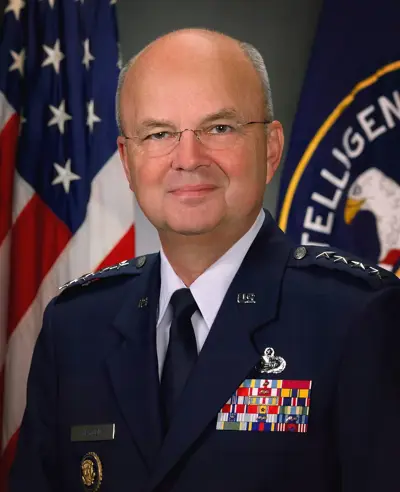
Michael Vincent Hayden is a retired United States Air Force four-star general and former Director of the National Security Agency, Principal Deputy Director of National Intelligence, and Director of the Central Intelligence Agency. Hayden currently co-chairs the Bipartisan Policy Center's Electric Grid Cyber Security Initiative. In 2017, Hayden became a national security analyst for CNN.
