Sonia Sotomayor Quotes
Unfettered discretion [in obtaining information could] alter the relationship between citizen and government in a way that is inimical to democratic society.
Sonia Sotomayor, United States v Jones 132 S. Ct. 945, 956 (2012)
Sourced by: Eigen's Political and Historical Quotations

The FBI had obtained a court order requiring apple to write software that could hack into a person's iPhone. Apple, with most other hi-tech companies in support, filed a motion with the court opposing the order. The FBI shortly thereafter withdrew its request for the order saying that they had found other solutions, when they had originally told the court that there were no other solutions. The issue however was and remains a very difficult political, moral, ethical, and legal conundrum.


The FBI had obtained a court order requiring apple to write software that could hack into a person's iPhone. Apple, with most other hi-tech companies in support, filed a motion with the court opposing the order. The FBI shortly thereafter withdrew its request for the order saying that they had found other solutions, when they had originally told the court that there were no other solutions.

He was the Chairman of the Senate Judiciary Committee.
He was the Chairman of the Senate Judiciary Committee. The Islamic fundamentalist terrorists are repugnant to us because they have no respect for Civil and Human Rights and would deny us what we value so highly and for which so many Americans have sacrificed. We are little better off if we surrender our civil rights in order to cope with the problem of losing our civil rights to the likes of the Taliban and Al Qaeda.


Snowden, was a contract worker for Booz Allan assigned to the National Security Agency (NSA). He felt that some of the NSA activities were illegal and unethical and tried to complain to NSA officials who rebuffed him. Despite the fact that he had signed an agreement not to do so, he copied many critical, classified documents that exposed much of the NSA activities that the NSA officials had denied existed—including lying under oath to the Senate. He then made many of them public, violating his oath, breaking the law, and opening up an entire area of government spying which most Americans knew nothing about and about which senior government officials had lied under oath to Congress. They of course wanted to prosecute Snowden who had told the truth, while they had lied. For many Americans, this became a moral and ethical conundrum.
The FBI had obtained a court order requiring apple to write software that could hack into a person's iPhone. Apple, with most other hi-tech companies in support, filed a motion with the court opposing the order. The FBI shortly thereafter withdrew its request for the order saying that they had found other solutions, when they had originally told the court that there were no other solutions. The issue however was and remains a very difficult political, moral, ethical, and legal conundrum.
The FBI had obtained a court order requiring apple to write software that could hack into a person's iPhone. Apple, with most other hi-tech companies in support, filed a motion with the court opposing the order. The FBI shortly thereafter withdrew its request for the order saying that they had found other solutions, when they had originally told the court that there were no other solutions.


The first non-PRI President in over 70 years.


See {635177} for the event that triggered the statement.

While this sounds good, in Taiwan it is not clear that the Premier has any authority over the intelligence agencies that is meaningful. Even in the United States Major intelligence leaders have lied to Presidents and the Congress about their clearly illegal activities, and many sceptics suggest that the Premier would have no way of knowing what his intelligence agencies are actually doing.


Snowden, was a contract worker for Booz Allan assigned to the National Security Agency (NSA). He felt that some of the NSA activities were illegal and unethical and tried to complain to NSA officials who rebuffed him. Despite the fact that he had signed an agreement not to do so, he copied many critical, classified documents that exposed much of the NSA activities that the NSA officials had denied existed—including lying under oath to the Senate. He then made many of them public, violating his oath, breaking the law, and opening up an entire area of government spying which most Americans knew nothing about and about which senior government officials had lied under oath to Congress. They of course wanted to prosecute Snowden who had told the truth, while they had lied. For many Americans, this became a moral and ethical conundrum.


Historically, the Privacy Issues have taken a long time to be reflected in laws or regulations. Technologists are far ahead of the lawyers and politicians.

For example, most of the documents that are classified as secret in the CIA are so classified because the censor thought the information might be damaging to the CIA’s interest, not the American citizen’s. However, there is a strange logic that is sometimes given to justify censoring material that would embarrass the agency: If the agency is embarrassed, public support and confidence in the agency will be eroded, and that in turn will cause investigations, reviews, and possible diminished budgets. This would be distracting from the agency’s mission of keeping Americans safe, so the public should be kept in the dark about embarrassing material.

Gates believed that ideally the government would have the trust of the people to access critical data, but that at the moment there are many who do not trust the government. Unfortunately, the FBI on many occasions have themselves broken the law and targeted people who had political and social viewpoints of which the FBI leadership did not approve. The CIA has on many occasions violated the law and repeatedly lied to Congress and even Presidents. The National Security Agency has also, in its zeal to carry out its mission skirted the law and the Director of National Intelligence blatantly deceived Congress and was exposed by the Snowden releases. Gates was an optimist and thought that the government could regain the necessary trust to allow it to have access to virtually all data in order to best protect society from things like terrorism with biological weapons.


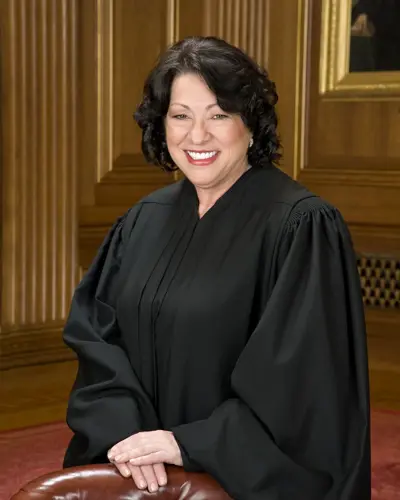
- Born: June 25, 1954
- Nationality: American
- Profession: Judge
Sonia Maria Sotomayor is an associate justice of the Supreme Court of the United States. She was nominated by President Barack Obama on May 26, 2009 and has served since August 8, 2009. Sotomayor is the first Hispanic and Latina member of the Court.
