Stanley A. McChrystal Quotes
I don’t know how many foreign fighters we captured who had come to fight because of Abu Gharib.
Abu Gharib was a prison in Iraq in which the officers in charge and the command structure failed to prevent a number of American soldiers from abusing and sexually and religiously humiliating Muslim prisoners. Photographs of the abuses traveled around the world and that particular unusual incident unfortunately fit the propaganda preconception of the Americans promoted by Islamic fundamentalist extremists. Tragically, as General McChrystal observed, Abu Gharib served as a recruiting tool for the terrorists.
Stanley A. McChrystal, Army General & Commander of Coalition Forces in Afghanistan, Interview, PBS The Charlie Rose Show, January 8, 2013
Sourced by: Eigen's Political and Historical Quotations

The American military and CIA officials made a number of errors in dealing with some of the prisoners. Once military desecrated a Muslim Holy Book with urine, many or the active and violent prisoners were kept in solitary confinement, but secrecy allowed Islamic propagandists to claim that this was done with almost all. Worst of all CIA interrogators were allowed to use ‘enhanced techniques’ (torture). Prisoners were not allowed to have reasonable contact to attorneys and where there were, these were monitored. Most of the prisoners were never charged with anything and yet they never received sentences and no one had any idea whether or not they would ever be charged, tried, sentenced or released. Even where there were some prisoners that the American authorities were willing to release, only a few were as their original counties would not accept them. Islamic extremist terrorist recruiters use Guantanamo to propagandize against America, and many new terrorist recruits were primarily motivated they claimed by the way that fellow Muslims had been treated in Guantanamo. Almost all agreed that Guantanamo was a negative, but it became very difficult to close it down and despite all the errors of operation, very few Americans were willing to return all these men to the battlefield to re-jojn the terrorists and other countries were unwilling to take the responsibility for their custody.


The German Green party was traditionally a left wing party, very concerned with civil rights and generally opposed to repressive use of police and military. However, faced with terrorism, the party would consider what under circumstances other than terror would have been unthinkable.

He was out of office when he made this statement.

The Justice Department and the White House were arguing that the Geneva Conventions did not apply to terrorist groups. See {589865}.

The President and Vice President wanted places to interrogate suspected terrorists where they did not have to obey American law, where the press could be kept away from the prisoners, and there would be no way that a prisoner could get the assistance of attorneys and American Judges could not have any jurisdiction. A number of the prisoners had been picked up by mistake, or were accused by people who had scores to settle, and if the CIA had made a mistake, the public could not find out. Further, they wanted to torture certain prisoners and wanted places where they could use their “enhanced interrogation”—see {637536}--without the public finding out.

ISIS captured a Jordanian pilot whose plane had crashed and they tortured him and burned him alive making and promoting a video of terrible war crime. At enormous cost Abdullah’s agents and soldiers tracked down those appearing in the video and killing them.

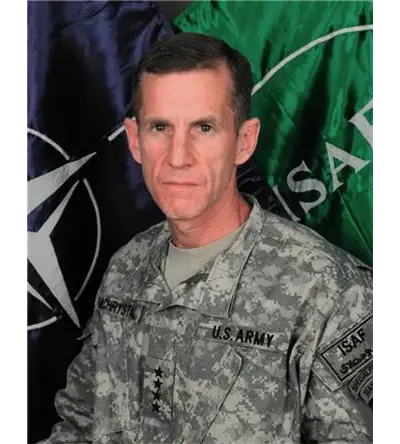
Stanley Allen McChrystal is a retired United States Army general best known for his command of Joint Special Operations Command (JSOC) in the mid-2000s. His last assignment was as Commander, International Security Assistance Force (ISAF) and Commander, United States Forces – Afghanistan (USFOR-A). He previously served as Director, Joint Staff from August 2008 to June 2009 and as Commander of JSOC from 2003 to 2008, where he was credited with the death of Abu Musab al-Zarqawi, leader of Al-Qaeda in Iraq, but also criticized for his alleged role in the cover-up of the Pat Tillman friendly fire incident. McChrystal was reportedly known for saying what other military leaders were thinking but were afraid to say; this was one of the reasons cited for his appointment to lead all forces in Afghanistan. He held the post from June 15, 2009 to June 23, 2010.
