John Locke Quotes
I do not say this, that I think there should be no difference of opinions in conversation, nor opposition in men's discourses... 'Tis not the owning one's dissent from another, that I speak against, but the manner of doing it.
Locke, John. Some Thoughts Concerning Education. A. and J. Churchill, 1693, p. 166.


Although a conservative think-tank, Brooks was gently chiding the Republicans who had swerved to the right and was constantly chiding the body politic using its morality as a cudgel and trying to force their morality into legislation much to the distress of the majority of voters.


In addition to the Attorney General, Washington’s cabinet consisted only of Thomas Jefferson, Secretary of State, and Alexander Hamilton, Secretary of the Treasury. Both were brilliant, passionate men dedicated to the new nation. However, they held opposite points of view on many major fundamental issues of political approach to the new nation. Washington greatly valued their advice and they each were magnificent administrators of their departments. However, they each distrusted each other intensely and believed that the other was advocating policies and practices that would destroy the new nation. Their squabbling was often public and Washington could never understand why they could not be civil about their disagreements. Ironically, Hamilton turned out to have been right about the assumption of state debt and the importance of business, finance and manufacturing. Jefferson whose vision had all Americans being farmers was wrong on this but was right on the limits of the executive and the rights of the individual vis a vis the government. Jefferson’s views turned out to be the ones most Americans wanted and his Democratic Republican party not only beat the Federalists but ended the Federalist Party. Hamilton died in a duel, Modern America is an amalgam of both of their views with modernity tending more and more towards Hamilton.


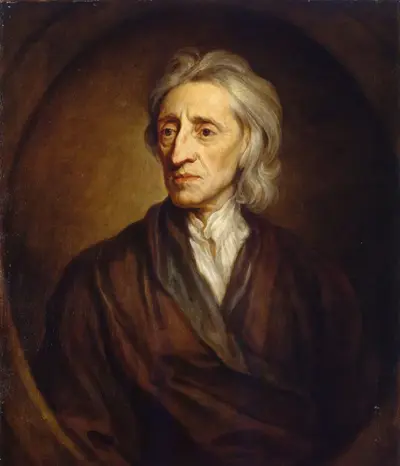
John Locke FRS was an English philosopher and physician, widely regarded as one of the most influential of Enlightenment thinkers and commonly known as the "Father of Liberalism". Considered one of the first of the British empiricists, following the tradition of Sir Francis Bacon, Locke is equally important to social contract theory. His work greatly affected the development of epistemology and political philosophy. His writings influenced Voltaire and Jean-Jacques Rousseau, and many Scottish Enlightenment thinkers, as well as the American Revolutionaries. His contributions to classical republicanism and liberal theory are reflected in the United States Declaration of Independence.
