Mustafa Kemal Ataturk Quotes
I could not bear the obvious mistakes made during the maneuver, and afterwards I criticized the pasha bitterly in the presence of all his officers, even though in doing so I exceeded my authority and my rank. The pasha looked hurt, but did not bear me malice…My behavior may have been contrary to discipline. But if a person trained in Germany does not work at the art of command, what can we expect of those who have not had this advantage? Perhaps when they see that they are criticized by their juniors, our commanders will learn to do better.
Kemal Ataturk, 1881-1938, 1st President and founder of the Turkish Republic, A statement responding to criticism of him for reprimanding the leaders of the army, August 1909, Quoted in Andrew Mango, Ataturk
Sourced by: Eigen's Political and Historical Quotations

History is replete with instances of military coups. In the final analysis, in every country at all times, there is no force in a society that could cope with a military which decides to act on its own. The Founding Fathers were very conscious of this reality and history, hence the firm civilian control of the military in America.


Miles, a hero of the Indian Campaigns (although he led the atrocities at the massacre at Wounded Knee) and then the leading military figure in America was an opponent of the policies of the new young President and had political aspirations of his own for the Presidency. Miles’ opinions were printed in the press. He maintained that he was not speaking as the Commanding General of the Army but personally as a citizen. The President surprised almost all by publicly scolding and reprimanding Miles when he next came to the White House. Five days later Roosevelt made the reprimand official, effectively ending Miles career. The issue of when senior military officers can criticize the administration has been debated ever since. Roosevelt was also a war hero himself, and although the military was shocked by such “savage” treatment of a senior officer, the President had public opinion on his side. Every decade or so there is a military official who does not care for the administration’s policies and expresses himself publicly. President Truman’s firing to General Douglas Macarthur was the most dramatic case, but Truman was well aware of the Miles and TR precedent.


Monroe was then Secretary of State and Jefferson an ex-President.


Eggleston was an accomplished writer who had served in the Confederate army of the Civil War. 20 year after the war he wrote a series of articles for the prestigious Northern Atlantic Monthly trying to convey the war from the Southerner’s point of view.

“Krauts” was a derogatory term for Germans. The American GIs loved Mauldin’s cartoons. However, much of the humor was directed at the Officers who were not as enthusiastic about the cartoons. The War Department didn’t agree with Patton and other officers who wanted the Mauldin Cartoons censored. They had determined that the cartoons were terrific for morale, and hence they printed them and distributed them to our troops the world over. See {629515} for Mauldin’s view of Patton.


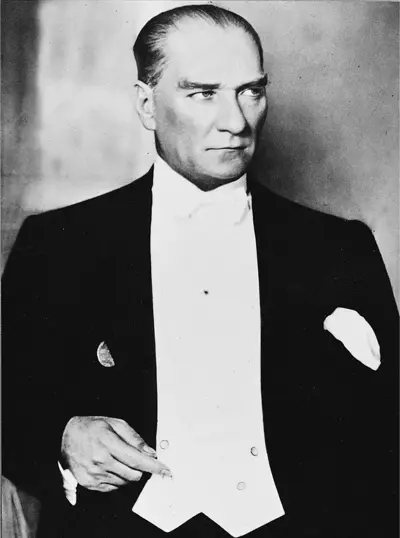
Kemal Atatürk was a Turkish field marshal, revolutionary statesman, author, and the founding father of the Republic of Turkey, serving as its first president from 1923 until his death in 1938. He undertook sweeping progressive reforms, which modernized Turkey into a secular, industrial nation. Ideologically a secularist and nationalist, his policies and theories became known as Kemalism. Due to his military and political accomplishments, Atatürk is regarded as one of the most important political leaders of the 20th century.
