Rodney Frelinghuysen Quotes
I can remember when President Nixon basically said, 'All troops have been withdrawn from the delta.' And I said, 'Wait, I'm still here.'
Frelinghuysen, Rodney. Interview by Sandra Stewart Holyoak and Shaun Illingworth. Rutgers Oral History Archives, Rutgers University, 13 May 2003.

Kerry was a decorated Vietnam War hero who opposed the war in its later years.

Had he signed such a treaty in 1968, he would have been pilloried by the Conservatives of both parties for selling out the interests and principles of the United States and shackling the military before they could win the war. The military was lying about their successes and there were very few. Further, our ally whose government we were protecting from armed revolution was totally corrupt and did not support freedom and democratic values much more than the North Vietnamese Communists did. The Vietnamese in the South had little to fight for unless they were proofing from the corrupt government. There was no possibility that American could have won the war under those conditions. When the Nixon Administration signed the treaty, some of the ultra conservatives objected, but Nixon was a Republican anti-Communist and red baiter and this blunted the opposition of the bulk of the conservatives who were seeing a more realistic view of the war. The liberals who hated Nixon, however, supported him on this matter which was then their most important issue.


Before the 1968 election, President Johnson, and gotten the North Vietnam Communists to agree to Peace Talks with the U. S. and South Vietnam. Then Candidate Nixon thought that if the peace talks were ongoing and making progress, there would be more support for the Democrats and Nixon's opponent Hubert Humphrey. So Nixon secretly send a secret emissary to South Vietnamese President Nguyen Van Thieu telling him that he would not get a very good deal because President Nixon claimed that President Johnson was too eager to end the Vietnam war. He suggested that if Thieu boycotted the peace talks, then when Nixon was elected, he would guarantee a much better deal for South Vietnam and Thieu personally. President Thieu boycotted the peace talks and there could be no progress. However there is a Federal Law, the Logan Act, that makes it a felony for a private American citizen to conduct or interfere with foreign policy or negotiations with a foreign government. President Johnson found out about Nixon's sabotage of the Peace Talks, called Nixon (see {583263}) and threatened him with prosecution if he interfered further. LBJ had decided that with the left wing at odds with the U. S. Government over the Vietnam war, a prosecution of Nixon would cause the Right Wing to challenge the government also and the country didn't need further polarization. He would do that only if Nixon did not heed the President's warning. But when Nixon won the election and became President, he was terribly anxious that his pre-election crimes would be made public, and spent much of his time and staff effort trying to find out who knew about his politically self-serving felony and who might make his crime public.

Nixon’s remark {583773} had been suppressed by the Nixon family and McGovern and the world first heard it 40 years after the fact.

Presidential aides John Erlichman & Robert Haldeman


Nguyen Vinh Thuy. and correct prediction


During his 1976 presidential campaign, Carter told reporters that they had treated him very well so far. "Compared to what?" asked one reporter. Carter shot back:

President Johnson was trying to organize peace talks in Paris. Nixon didn’t want a public announcement to occur before election day when he was running against Hubert Humphrey. Knowing the South Vietnamese President was reluctant to go to Paris but was under pressure from America to do so, he sent a message through Chennault that he should not accept and “hang on” as Nixon would shortly win. The South Vietnam president refused to go to Paris, Nixon won the election, and then had to cope with the continuation of the war that might well have ended before he took office. Nixon believed that he could get Russia and China to pressure Ho Chi Min to make peace. Nixon's private overtures to the South Vietnam president, violated the Logan Act which prohiited private citizens negoatioating with foreign governments. President Johnson was aware of Nixon's commission of this felony want wanted to prosecute him, but the evicence had been obtained from secret intelligene agency bugging and wiretapping both the South Vietnam Embassay in Wishington and the Presidential Palace in Vietnam the public knowledge of which would have caused a scandal. Instead, he called Nixon and warned him to stop, but the damage had already been done, and the South Vitenamese government would not go to Pariis where they would have to agree to a coalition government with the Communists. THey waited for Nixon to deliver a peace treaty which would leave them in charge of South Vietnam. In the final analysis, the South Vietnamese ended up with nothing and no participation in anything when the U. S. Withdrew and the Communists took over.


There is no written record of this conversation. The source is the Nixon Oval Office tapes.

The President was lying. American special forces were operational in Cambodia. This is the kind of deception that is puzzling to many in that the enemy knew there were American forces in Cambodia as did our closest allies. The logic of the deception was to not give the Communists a chance of a propaganda advantage by claiming that the U. S. was escalating the war. Cynics claim that Nixon was more concerned with not letting the American public and Congress know that he was widening the war.
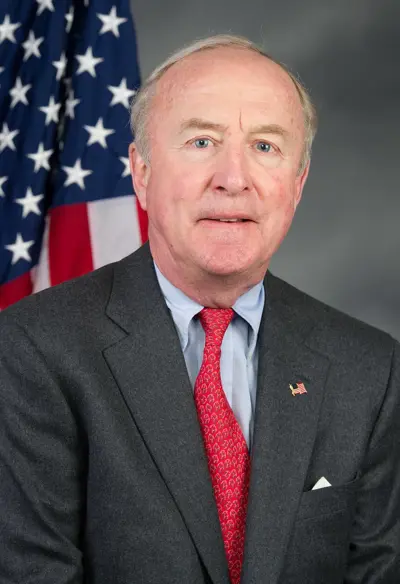
Rodney Procter Frelinghuysen /ˈfreɪlɪŋˌhaɪsən/ is an American politician who served as the U.S. Representative for New Jersey's 11th congressional district from 1995 to 2019. The district includes most of Morris County, an affluent suburban county west of New York City. It also includes some of the wealthier areas near Newark and Paterson, and is the 10th richest congressional district in the nation in terms of median income. A member of the Republican Party, Frelinghuysen served as Chair of the House Appropriations Committee from 2017 to 2019. Frelinghuysen announced on January 29, 2018, that he would not seek re-election that year.
