H. R. Haldeman Quotes
Out of the gobbledygook comes a very clear thing: you can't trust the government; you can't believe what they say; and you can't rely on their judgment. And the implicit infallibility of presidents, which has been an accepted thing in America, is badly hurt by this, because it shows that people do things the President wants to do even though it's wrong, and the President can be wrong.
There is no written record of this conversation. The source is the Nixon Oval Office tapes.
H. R. Haldeman, 1926-1993, White House Chief of Staff (Republican), Summary of the problem of the Pentagon Papers for the Nixon Administration, Statement to President Richard M. Nixon, June 14, 1971
Sourced by: Eigen's Political and Historical Quotations


If a government can classify embarrassing information, then it does not have to lie which is why over-classification is so prevalent. But then the officials have to lie in the classification process by claiming national security is involved as opposed to their own or their party’s security from embarrassment. Most officials prefer to tell the truth and not deceive the public. However, a large proportion have their moral instincts compromised by confusing the national interest with the politicians’ interest


The memo proposed having a good novelist write a fictional novel with Nixon as the main character. The great Nobel Laureate John Steinbeck was approached for the project. See {629628} for his reaction.

Taken from the Nixon Tapes of June 14, 1971. This quotation illustrates the mental set of the Nixon White House where the President must be seen as infallible and obeyed without much questioning. After Nixon, that view did not surface again in American politics until the George W. Bush Presidency. The Federal Courts were not very sympathetic to the Haldeman assertion and allowed the publication.


Before the 1968 election, President Johnson, and gotten the North Vietnam Communists to agree to Peace Talks with the U. S. and South Vietnam. Then Candidate Nixon thought that if the peace talks were ongoing and making progress, there would be more support for the Democrats and Nixon's opponent Hubert Humphrey. So Nixon secretly send a secret emissary to South Vietnamese President Nguyen Van Thieu telling him that he would not get a very good deal because President Nixon claimed that President Johnson was too eager to end the Vietnam war. He suggested that if Thieu boycotted the peace talks, then when Nixon was elected, he would guarantee a much better deal for South Vietnam and Thieu personally. President Thieu boycotted the peace talks and there could be no progress. However there is a Federal Law, the Logan Act, that makes it a felony for a private American citizen to conduct or interfere with foreign policy or negotiations with a foreign government. President Johnson found out about Nixon's sabotage of the Peace Talks, called Nixon (see {583263}) and threatened him with prosecution if he interfered further. LBJ had decided that with the left wing at odds with the U. S. Government over the Vietnam war, a prosecution of Nixon would cause the Right Wing to challenge the government also and the country didn't need further polarization. He would do that only if Nixon did not heed the President's warning. But when Nixon won the election and became President, he was terribly anxious that his pre-election crimes would be made public, and spent much of his time and staff effort trying to find out who knew about his politically self-serving felony and who might make his crime public.


Nixon however turned out to be very dishonest with the Watergate scandal allowing the public to see and hear what Nixon was really like. He was the only American President who resigned, as he did that to save himself from being impeached and tried for various fenonies he committed. Vidal had his number. However, Nixon was not a crook in the usual sense of the word. His violations of law and ethics did not enrich him fiscally. His corruption was the drive and mania for power and control.


At the time there was no Secrecy & Classification System nor any laws enforcing secrecy or confidentiality. However there was no freedom of information laws of expectations even on the part of journalists. This was the first Freedom of Information policy of the American government. Some politicians were more open than others but there was no national, governmental before this. There were however leakers and whistleblowers though the terms were not in use. Note that Roosevelt herein created the first whistle blower protection—himself.


Haldeman had actually called the network executives on several occasions regarding Cavett’s show. Nixon was particularly furious when Cavett interviewed John Kerry, the decorated soldier who had thrown his medals away in protest to the handling of the Vietnam War. Nixon wanted some stronger actions taken.


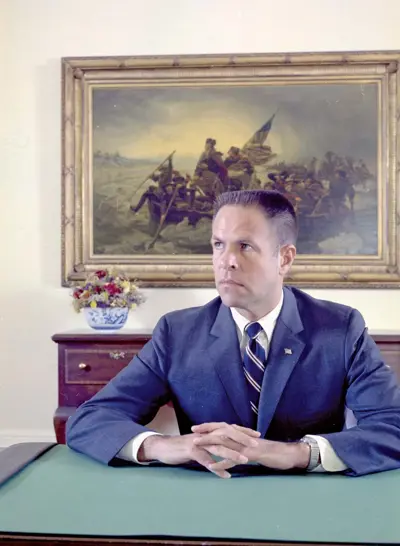
Harry Robbins "Bob" Haldeman was an American political aide and businessman, best known for his service as White House Chief of Staff to President Richard Nixon and his consequent involvement in the Watergate scandal.
