Girolamo Savonarola Quotes
I announce to you that your life is near its end; that if you obey not my words, you will go to hell, and this letter will be brought up against you before the judgment-seat of God, and leave you no way of escape.
In addition to the immense secular powers that can be used to obtain obedience, in a theocracy, there is the additional weapon of damnation. See {628182} for his use of some of the others.
Girolamo Savonarola, 1452–1498, Italian Dominican priest and ruler of Florence from 1494-1498, To the prince of Mirandola, Count Galeotto Pico, brother of Giovanni Pico della Mirandola (26 March 1496),, Quoted in Pasquale Villari, Life and Times of Girolamo Savonarola, 1888
Sourced by: Eigen's Political and Historical Quotations

government appointed officials and bureaucrats Savonarola was a very hated ruler, opposed to any kind of a Parliament or assembly. And the penalty for advocating for a Parliament was severe. The Signoria were the various government appointees and clerks. They were influential in Florence and hence they were silenced by the mot draconian methods. There was a movement throughout Italy for parliaments and less arbitrary government. Savonarola was particularly strict in his rooting out sin and cruel in his punishments and hence very unpopular. He was also under the delusion that God himself had called on him to preach his strict version of morality. Some of the Nobles reached the Pope with many of Savonarola’s extreme statements and Savonarola was excommunicated and burned as a heretic. His executioner gloated that he was burning Savonarola before the powerful priest could burn him as he had done so many others.


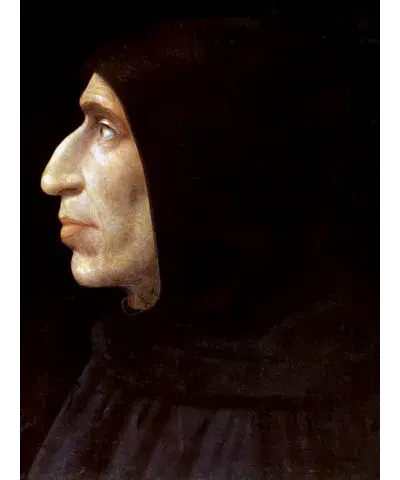
Girolamo Savonarola was an Italian Dominican friar from Ferrara and preacher active in Renaissance Florence. He was known for his prophecies of civic glory, the destruction of secular art and culture, and his calls for Christian renewal. He denounced clerical corruption, despotic rule, and the exploitation of the poor. He prophesied the coming of a biblical flood and a new Cyrus from the north who would reform the Church.
