Andrew Jackson Quotes
I am one of those who do not believe that a national debt is a national blessing, but rather a curse to a republic; inasmuch as it is calculated to raise around the administration a moneyed aristocracy dangerous to the liberties of the country.
Andrew Jackson, 1767 - 1845, 7th President of the United States, Letter to T. H. Colman, April 26, 1824
Sourced by: Eigen's Political and Historical Quotations

See {604501} for another of his statements. It was Alexander Hamilton who called the national debt a national blessing. See {207891}. Jackson was convinced that a moneyed class who held the national debt could dictate to any administration by threatening to not renew their bonds. The same concern was expressed at the beginning of the 21st century regarding the Chinese and the Middle Eastern countries which held do many of our bonds.

This was in the midst of the debate over The Recharter Of The Bank bill

Muir had spoken at the Convention of Scottish Friends of the People at Edinburgh in 1792. He had advocated election reform allowing all men to vote, not just property owners and was sentenced by Braxfield to the Australian penal colony at Botany Bay. Braxfield expressed the deep distrust the establishment felt even for merchants, traders and others with fungible assets.


The Laffer curve was a mathematical, economic curve supposedly showing the relationship between tax rate and government revenue from taxes. In Laffer’s version of this curve, as interest rates go down, revenue from taxes goes UP because according to Laffer, there will be much more economic activity if taxes are lowered. In reality this has happened rarely in certain countries and in a very narrow range of tax deduction. As Chretien observes if you lower the tax rate to zero according to the Laffer curve this should maximize revenue but obviously it does not because with a zero rate there are no taxes collected even if the economy is booming. The Laffer curve was ideologically popular with those politicians wanting to lower taxes, but it never stood up to serious analysis and never worked in practice as Chretien observes. As a result, some people refer to the curve as the Laughter curve.

This is a an interesting political and historical quotation because it shows how left and right gets redefined in each age. Here we have a quotation of two sentences. By 21st century American definitions, the first statement would line Say up with the Right Wing. The second clause of the second sentence could have been written by an extreme Marxist and would be Left Wing. Definitions and norms change and individuals even change their positions as they have more experience and reflect more on their views.


Although this was written in 1924, it could have been written at most times since where the national debt was substantial.


The working and middle class wages and other income had been static for over 20 years while the wealthy had theirs increase several fold. The “rising tide” only lifted the largest boats.


The crisis of inequality of income and wealth has occurred seven times in American history.

In 1775 England had amassed a large national debt and was looking to the American colonies as one source of revenue for debt reduction.
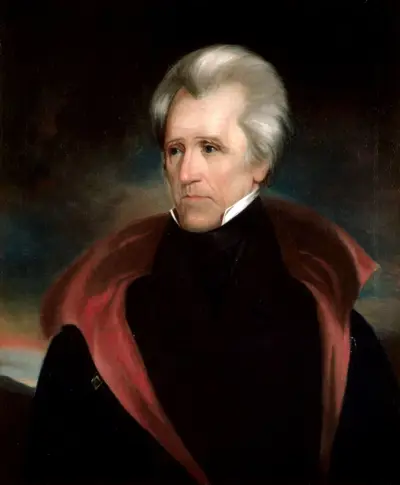
- Born: March 15, 1767
- Died: June 8, 1845
- Nationality: American
- Profession: President
Andrew Jackson was an American lawyer, soldier, and statesman who served as the seventh president of the United States from 1829 to 1837. Before being elected to the presidency, Jackson gained fame as a general in the United States Army and served in both houses of the U.S. Congress. An expansionist president, Jackson sought to advance the rights of the "common man" against a "corrupt aristocracy" and to preserve the Union.
