Saddam Hussein Quotes
I am not going to answer to this so-called court, out of respect for the truth and the will of the Iraqi people. I've said what I've said, and I'm not guilty.
Worth, Robert F. "Defiant Hussein Rebukes the Judge at Trial's Start." The New York Times, 20 Oct. 2005.


This Proclamation was issued upon arrival of the British occupying imperial army in present day Iraq. The English policy makers like the Bush administration almost a century later were expecting a more welcoming reaction. See {585250}.

The highest court in New York. This was the generally accepted view of international law until WWII when atrocities and crimes against humanity were coped with. Also, at the time of this writing America was a small emerging state and not one of the great powers. Hence the prohibition of even commenting on the internal affairs of another nation was important to us. Now that America is a superpower, and society is more concerned with human rights, the point of view has changed.

This quotation is an excellent example of a kind of political statement that sounds terrific at first, but when you think about it, it is hard to determine what it means. It is clearly some kind of criticism of international and multinational organizations but it is impossible to know what the candidate is proposing. He does not urge that the US not participate in the multilateral organizations? He warns that when we do participate, we should not cede our moral authority to them. But no one can determine had a sovereign nation like the United State cedes any moral or other kind of authority by participating in these organizations.


3rd Viscount Palmerston. Lajos Kossuth was the Hungarian leader of anti-monarchists who were agitating for a Parliament. While many English people sympathized with Kossuth, his government, which had good relations with England, did not want any of the other European Governments to officially meet with him. It was considered insulting to a government if a friendly government met officially with a politician who was not approved by his own government. Palmerston, as Temple was referred to, wanted to show English sympathy with the reforms advocated by Kossuth. He was then the Foreign Minister and wanted to invite Kossuth to the Foreign Ministry. However the Cabinet had a meeting and voted against the idea which would not only inflame the Hungarian government, but would outrage all the other countries in Europe for this diplomatic insult. Palmerston then decided that he would meet with Kossuth in his private residence. When the Prime Minister discovered this plan, he sent a note by messenger telling Palmerston that he was the Foreign Minister and inviting Kossuth to his home could not be seen as an official action. Palmerston has his own political base and had enough supporters in Parliament that if he would be fired, he could bring down the coalition government. So in effect he told his Prime Minister off and dared Russell to fire Palmerston. Then he went ahead with the meeting. The cabinet was upset, Queen Victoria was outraged (she never cared for Palmerson as a Foreign Minister), the Newspapers had a field day, and all the European counties complained vehemently to the Queen and the Prime Minister. But Russell didn’t dare fire Palmerston at that point. However, with Queen Victoria’s shrewd political maneuvering and Russell coalescing support, he was able to demote Palmerson to Home Secretary and assume the Foreign Ministry himself in 1952. However, Palmerston had the final winning hand, when 3 years later, he was elected Prime Minister and he and the Queen had to make a rapprochement.

This newspaper was an English language organ published by General Allenby’s British and Allied forces in the Middle East. Prior to the war, the Middle East was all part of the Ottoman Empire. However, the Ottoman Turks sided with Germany in WWI and their Middle East dominions were targets for the allied military strategy.

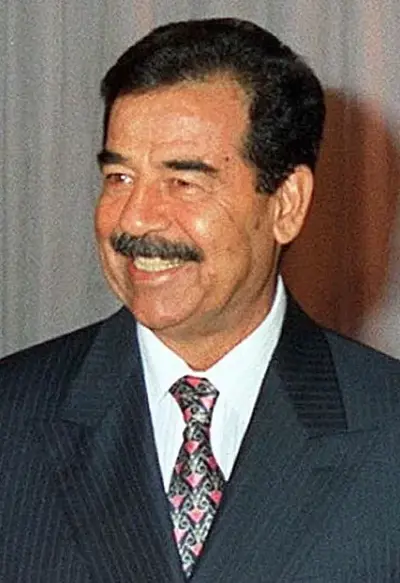
Saddam Hussein Abd al-Majid al-Tikriti was an Iraqi politician who served as the fifth President of Iraq from 16 July 1979 until 9 April 2003. A leading member of the revolutionary Arab Socialist Ba'ath Party, and later, the Baghdad-based Ba'ath Party and its regional organization, the Iraqi Ba'ath Party—which espoused Ba'athism, a mix of Arab nationalism and Arab socialism—Saddam played a key role in the 1968 coup (later referred to as the 17 July Revolution) that brought the party to power in Iraq.
