Lord Byron Quotes
I am no Platonist, I am nothing at all; but I would sooner be a Paulician, Manichean, Spinozist, Gentile, Pyrrhonian, Zoroastrian, than one of the seventy-two villainous sects who are tearing each other to pieces for the love of the Lord and hatred of each other.
Byron, George Gordon. The Works of Lord Byron: Letters and Journals. Vol. 2, John Murray, 1898, p. 35.

There is of course no way to tell the sect of a Muslim by physique alone, although there are major behavioral differences. The reason the quotation was newsworthy was that it was amazing that a senior Senate leader was so ignorant of such a critical and problematical subset of the world.


Barton and some other Christian Fundamentalists did not believe that a prayer should be offered by a religion that was not monotheistic. Some actually disrupted the Senate prayer in protest. See {583752}.


He had been an eye-witness to the Massacre of the Parisian Protestants as a young man.


Odo of Chatillon-Sur-Marne. This is an amazingly distressing quotation for most moderns. Here we have the Pope preaching genocide and ethnic cleansing. This was one of the main triggers of the bloody Crusades and is not forgotten by Muslims in the Middle East Today. As Islam has not changed a great deal in 1000 years, most Muslims assume that the same is true of Christianity and especially the popes and the Roman Catholic Church. This is one of the reasons that the Islamic world reacts so strongly when a pope makes any statement negatve about Muslims and Islam.


At the time there was an issue of religious freedom that is in public discourse: It emanated from the Obama Care law which required employers to provide health insurance that does not discriminate against women by refusing to disallow coverage for birth control (pills, diaphragms, etc.) This legislation covered the employees of general institutions run by religions such as schools, hospitals, and retirement communities. Roman Catholics and other religions which viewed birth control as a sin were put in a position where they had to pay for something that they regarded as sinful. So the church did not have complete religious freedom. However, if these institutions would deny to their employees a basic right that the law says belongs to all institutions. If an exception would be made for birth control what about blood transfusions. The Jehovah’s Witnesses believe that autologous blood transfusions are contrary to the world of God. So what if institutions they run decided to not cover these transfusions in their insurance policies? Or a Jewish University or a Muslim cultural center decided not to cover medical procedures in hospitals that serve pork? There have been many examples where one religion’s freedom has been curtailed slightly when they conflict with individual rights or other rights. Plural marriage for Mormons and Muslims are against the law. Christian Scientists have been forced to provide medical care for some members even though their religion prohibits it. There is no solution that will not curtail someone’s rights under some circumstances.

Samuel Langhorne Clemens, 1835-1910
The amazing thing about this quotation of 1913 is that at the end of the 20th century the Christians were again at the Muslims throats and Bosnian Muslims were being murdered and ethnically cleansed by the Roman Catholics of Croatia and the Eastern Orthodox Christians of Serbia. The hatred had persisted—the legacy of 1000 years before.


In this speech, and in {634756}, he argued against unification to a public that was mostly opposed. The leadership was interested because they were facing the Muslim Ottoman Turks who were getting more powerful each day. The Eastern Emperor, Constantine XI, more of a soldier and politician than a cleric, wanted the military strength of the Franks and other Western European Christian armies to help protect the Eastern Empire and Byzantium and were willing to reunite under the Pope to get it. Gennadios and his faction were not. They prevailed and the next year, the Muslims conquered Byzantium which had little help from the armies of the Western Roman Empire.
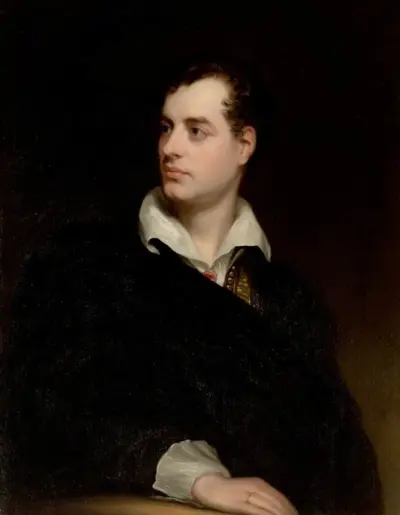
George Gordon Byron, 6th Baron Byron, FRS known simply as Lord Byron, was an English peer, who was a poet and politician. He was one of the leading figures of the Romantic movement and is regarded as one of the greatest English poets. He remains widely read and influential. Among his best-known works are the lengthy narrative poems Don Juan and Childe Harold's Pilgrimage; many of his shorter lyrics in Hebrew Melodies also became popular.
