John Kerry Quotes
I actually did vote for the $87 billion before I voted against it.
Kerry like many other members of Congress have to vote on large omnibus appropriations, on amendments that are proposed, and on procedural votes. None of these votes are on exactly the same issues or phrased the same way. None the less, when Kerry was accused of being on both sides of the question of the Iraq war, he made this statement, which was quoted over and over in attack ads against him which made him out to be indecisive and someone who could never make up his mind. It is a wonderful quotation what illustrates how a Politician can create a large problem for himself by being careless about the wording of a statement. A Politician has to consider how any single sentence he utters, can be made to sound when framed in an attack ad and taken out of context.
John F. Kerry, U. S. Senator (Democrat, MA), U.S. Secretary of State, Democratic Nominee for President, San Francisco Chronicle, March 21, 2004
Sourced by: Eigen's Political and Historical Quotations


In subsequent years military officers got around this restriction by privately expressing confidential opinions to members of Congress and the press. In the Iraq war for example most senior military officers felt that more troops were needed in Iraq. However, since the President decided on the final troop count only one official, the Army Chief of Staff, has publicly expressed the view that it was insufficient. He was retired early. The stricture still stands.


Many members of his own party opposed some of the President's policies and programs, and party loyalty and discipline were strained:


Both the House and the Senate, as they got larger, developed an Appropriations Committee. When the committee assessed a departmental appropriation, they had also the responsibility for all the other departmental budgets. However, many of the members of the Appropriations Committee tended to favor the interests of their particular constituency or the special interests to which they were beholden. Other members had little or no influence. So there was immense pressure during Reconstruction to ‘share’ the appropriations ‘plum’ by creating appropriations subcommittees. However, each particular subcommittee loses the perspective of and interest in the budget as a whole. The process has led to budget imbalance pressure ever since. But Randall, the Speaker of the House warned about exactly what would happen. He had earlier served as Chairman of the Appropriations Committee, and he was exactly right.


Because of the filibuster and other procedural individual prerogatives, it is easy for a few Senators or often a single Senator to prevent a bill from ever coming to a vote. Much imaginative and excellent legislation has died in the United States Senate.

The President-elect was very circumspect with respect to Congress:

Discussing the care that must be taken in drafting tax legislation:

Goldwater was the first Republican Presidential Candidate since the end of WWII who had campaigned for smaller government and reduced government spending. He actually started the modern Republican trend toward campaigning on this theme. Ronald Reagan did a much better job of campaigning on this theme, and all Republican Candidates since have campaigned on these two themes. It is not clear whether the Republicans were actually serious about this or just ran on the themes to please the political wing that Goldwater had started or meant it but were not good enough at running the government to fulfill this promise. Every Republican President from Reagan through George W. Bush increased the government spending and increased the number of government employees—more so than most Democrats ironically. Democratic President Bill Clinton was the only post WWII president to cut spending, produce a surplus and diminish the size of the government bureaucracy. Goldwater was so intellectually honest that had he won, he probably would have done everything he could to implement the policy of smaller government and less spending.
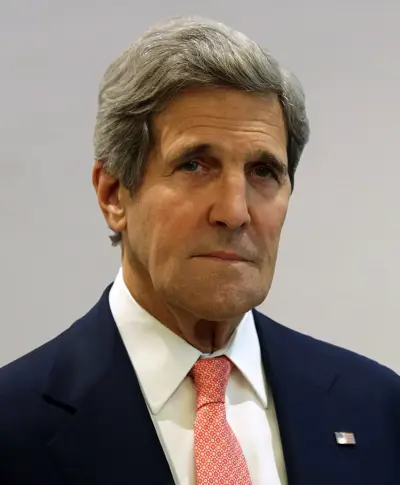
John Forbes Kerry is an American politician and diplomat serving as the United States Special Presidential Envoy for Climate. He previously served as the 68th United States Secretary of State from 2013 to 2017. An attorney and former naval officer, Kerry first drew public attention as a decorated Vietnam veteran turned anti-war activist. He went on to serve as a prosecutor and as Lieutenant Governor of Massachusetts, before serving as United States Senator from Massachusetts from 1985 to 2013. A member of the Democratic Party, he was the Democratic nominee for President of the United States in the 2004 election, which he lost to incumbent President George W. Bush. He is the last Democratic presidential candidate to date to lose the popular vote.
