John Glenn Quotes
At a time of tight budgets, unless something is really broken and not working, they [his congressional colleagues] just don't get excited about it.
John Glenn, U.S. Senator (Democrat, OH), Quoted in New York Times, October 16, 1988
Sourced by: Eigen's Political and Historical Quotations


In 1964 the treasury secretary asked the president how to sell the proposed budget to Congress:

This quotation pithily summarizes a common problem in politics of describing budgets. In most years there has been a national inflation. If a new budget is, in actual dollars, the same as the previous years or a little more, but the increase is less than the inflation level, the agency will not be able to provide the same level of services as the previous year. Therefore services will be cut and those who are politically in favor of more money for the program legitimately describe this as a “budget cut”. Opponents of larger funding increases, also legitimately describe the funding as a “budget increase”. One side refers to what the money can buy and the other, to the absolute dollars spent. This is an example of the classical ambiguity of political oratory.

Bloomberg was one of the few people who say the meltdown of 2008 coming. His principle of saving a surplus for spending in the downturns, which served New York so well goes against most Democrat and Republican politicians. If there is a surplus, the Democrats want to spend it. The Republicans want to cut taxes and return the surplus. Neither is prepared for an economic slowdown.

1st Viscount Snowden


Roosevelt understood the value of symbols in forming public perception, and vetoes are often used by presidents to create a symbolic message.


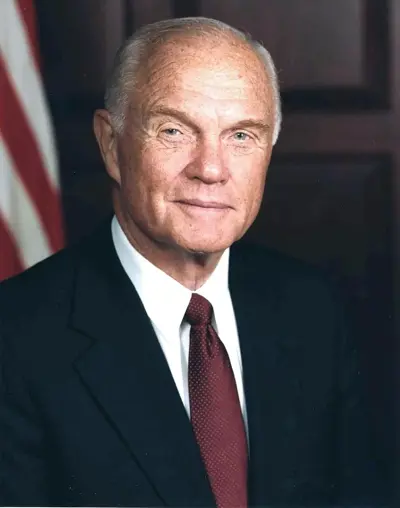
John Herschel Glenn Jr. was a United States Marine Corps aviator, engineer, astronaut, businessman and politician. He was the third American in space, and the first American to orbit the Earth, circling it three times in 1962. Following his retirement from NASA, he served from 1974 to 1999 as a Democratic United States Senator from Ohio; in 1998, he flew into space again at age 77.
