Marie Curie Quotes
Humanity also needs dreamers, for whom the disinterested development of an enterprise is so captivating that it becomes impossible for them to devote their care to their own material profit. A well-organized society should assure to such workers the efficient means of accomplishing their task, in a life freed from material care and freely consecrated to research.
Marie Curie, 1867-1934, Polish Born French Scientist & Double Nobel Prize Winner, Madame Curie: A Biography by Eve Curie, 1938
Sourced by: Eigen's Political and Historical Quotations


Canute was a Scandinavian king who tried to control the ocean tides to show his power. In this particular case, the court ruled that new life forms could be patented.


This quotation became the mantra of the MIT Media Lab's Professor Hugh Herr and others whose total efforts are spend inventing things for the future.


This quotation illustrates a way in which science is frequently at odds with politics. Our politicians realize the importance of scientific research to our standard of living, economy, and quality of life. So they want to support research and development programs. However, budgeting and planning for these in terms of expected or desired results is virtually impossible. So scientific research, especially basic research is not susceptible to the usual planning and monitoring that is so common and effective in construction projects or other applications of science and technology. It is hard to predict when and which scientists will have the next critical idea. It is very difficult to hold scientists or administrators accountable for scientific research results because of this factor. See {624876}.

Many of his greatest ideas were not sufficiently appreciated by many other scientists nor the businessmen who funded scientific projects then. Tesla was one of the great American immigrant scientists. He found in America the kind of intellectual and operational freedom that did not exist in the rigid, monarch-controlled, Austro-Hungarian Empire. He developed patents and techniques that formed the technological bases of radio, telephone long distance, TV, cell phones, Wi Fi, just to name a few. Most important he was Thomas Edison’s great nemesis. Edison invented DC electric generators that could power factories or entire streets in a neighborhood. Tesler invented and developed AC electrical technology which could power entire cities and he could move electricity over long distances which Edison could not. Tesler was one of the first scientists to conceive of and try to implement “Big Science” where there were huge capital investments to develop machines and systems to do what had never been done before—philosophically like the CERN Hadron Collider. Tesler even convinced a large corporation to finance the construction of a massive building and tower so he could experiment with the wireless transmission of electricity. However, as the industrial democracies have learned, Big Science can only be funded by governments and it often takes sever working in consort to afford the huge investment that is required. In Tesler’s era, the federal and state governments did not fund scientific research so his work was not only technically ahead of his time but also conceptually. He anticipated most of the problems and need for a national power grid that was challenging America even at the beginning of the 21st century.

He was observing that from a public policy point of view, it is very difficult to target research funds on projects that will have practical innovations because so many come from basic research or research in an entirely different field of science.


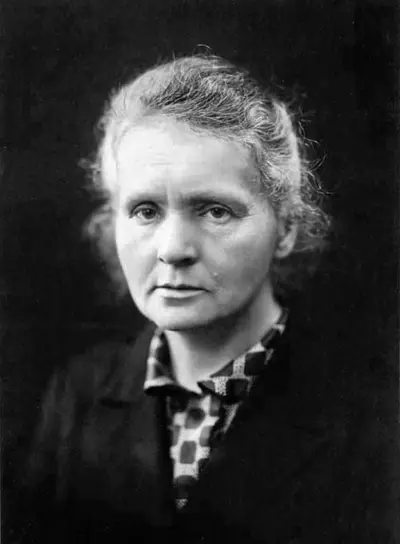
Marie Skłodowska Curie (/ˈkjʊəri/ KEWR-ee; French: [kyʁi]; Polish: [kʲiˈri]), born Maria Salomea Skłodowska, was a Polish and naturalized-French physicist and chemist who conducted pioneering research on radioactivity. As the first of the Curie family legacy of five Nobel Prizes, she was the first woman to win a Nobel Prize, the first and the only woman to win the Nobel Prize twice, and the only person to win the Nobel Prize in two scientific fields. She was the first woman to become a professor at the University of Paris in 1906.
