John Calvin Quotes
How many priests, pray, are free from whoredom? Nay, how many of their houses are infamous for daily acts of lewdness? How many honorable families do they defile by their vagabond lusts? For my part, I have no pleasure in exposing their vices, and it is no part of my design; but it is of importance to observe what a wide difference there is between the conduct of the priesthood of the present day, and that which true ministers of Christ and his church are bound to pursue.
John Calvin, 1509-1564, Lawyer and Protestant Minister, Founder of Calvinism, The Necessity of Reforming the Church, 1543
Sourced by: Eigen's Political and Historical Quotations


Jefferson was not anti-Christian as some accuse him. He was a great admirer of Jesus’ life and philosophy. He did object to the non-ethical aspects of Christianity—the rituals, miracles, dogma, hierarchy, and organized churches. See {611664} . Jefferson even went so far as to compile his own version of the Bible—New Testament sometimes called the “Jefferson Bible”—where he translated the material and then extracted the ethical principles leaving out everything else.

The Roman Catholic Clergy as well as the Vatican was quite corrupt in Luther’s time which was one of the reasons for his reform effort. Throughout history some clerics have abused their positions and roles and acted as impediments to the faith in their own religions.


The Islamic Holy Book even recommends against friendships with Christians and Jews. See {584381}.
Jefferson was a deist but had little love for the organized religions and did not consider the Bible as the revealed word of God.

The Illuminati was a secret society. At the time, anyone who differed with the Church on issues of philosophy, ethics or religion could be tortured and burned at the stake, and anyone who criticized the Monarchy could be tortured and hung or beheaded. The result was the concept of a secret society of which the Illuminati was one.

Ingersoll was considered to be the greatest orator and political thinker of his day, but his overt atheistic views curtailed his elected political career.


He was the last Pope to hold temporal power.


Although a Protestant Minister himself he called for major reform of the church. He made little headway except to inform public opinion. He died in prison where he was incarcerated for “libel and sedition” major crimes in England at that time which had no freedom of speech or of the press guaranteed by a Bill of Rights.

In 1877 Wasburn was dropped from the List of Ministers by the Unitarian Church. He had become very critical of organized and orthodox religion of all kinds.

He argued that the clergy should cease to own lands and peasants and that bishops and the Pope should give up their temporal power. He was labeled a heretic for these views.

Clerics of the age were often combinations of fund raisers and tax collectors.

When the priest died, 3 handwritten manuscripts were found written and signed by him in which he attacked religion in general and the church and the Bible in particular. His Testament was read by Voltaire and Denis Diderot among others and he was very influential in their development as opponents of organized religion. This quotation has been one of the bases of secular humanism which would then develop after he had died.
The King had earlier replaced the Pope as the head of the English church. The references to money referred to a then common corruption of the Church whereby people could buy indulgences—religious papal pardons of past or future sins. This was a major revenue source for the Vatican and a major issue for Martin Luther and the Protestant Reformers some of who saw the pope as the Devil incarnate See {623153}. For Martin Luther’s view pf the practice and {626720}, {595195}, and {639436} for other contemporary views.

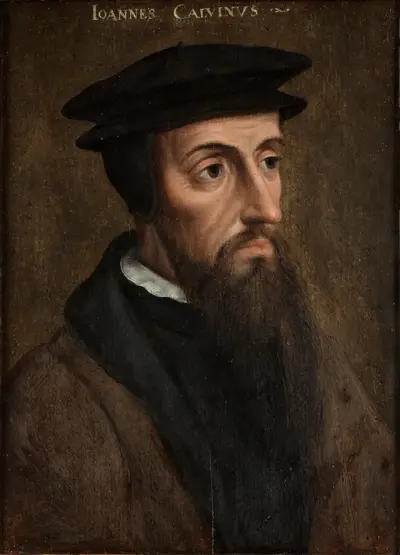
John Calvin was a French theologian, pastor and reformer in Geneva during the Protestant Reformation. He was a principal figure in the development of the system of Christian theology later called Calvinism, aspects of which include the doctrines of predestination and of the absolute sovereignty of God in salvation of the human soul from death and eternal damnation, in which doctrines Calvin was influenced by and elaborated upon the Augustinian and other Christian traditions. Various Congregational, Reformed and Presbyterian churches, which look to Calvin as the chief expositor of their beliefs, have spread throughout the world.
