Maxim Gorky Quotes
History would have told them [the people] how half-literate priests taught the working people patience and submission to the "authorities appointed by God"; how peasants were made monks by force and monasteries built with their man-power; how the number of "lay parasites" was swollen and brought into being, in which the peasant worked with a plough and his parasite with a spoon. To increase its power and influence over the ignorant people, the church staged flimsy tricks which it called "miracles," from the boyars it created "saints," men of God--all for the benefit of the authorities. The main task of all churches was one and the same: to impress upon the poor serfs that there was no happiness for them on earth; happiness was prepared for them in heaven, and meanwhile back-breaking toil for some other fellow was pleasing in the sight of God.
Aleksei Maximovitch Peshkov
Maxim Gorky 1868-1936, Russian Writer, The People Must Know Their History!,” Culture and the People, 1939
Sourced by: Eigen's Political and Historical Quotations

Aleksei Maximovitch Peshkov. When some people currently refer to “class warfare” this is the kind of polemic from the left that parallels the rightist propaganda on the other side. In both cases, the worst examples of behavior of a groups is attributed to the class as a whole.

The Radical Religious Right in America did not have its origins as a reaction to the 1960s as some believe. It was present among the Know Nothings in the 19th Century, the KKK in the aftermath of Reconstruction, and during the Second World War.


This is a very important quotation as Kingsley was a precursor of Karl Marx in claiming that religion was used as opium for suppression of people. See Marx {624064} It is probable that Marx had read Kingsley’s quotation but there is no way of knowing for sure. What is certain is that Marx did not originate the idea.


Despite the fact that many Americans saw communists and socialists as of the same ilk, socialists were very suspicious of communists—especially the “party discipline” and the lack of individual freedom, while the communists saw the socialists as just another form of fascism and attacked it violently. Later, the party line against socialists softened as Cold War communist strategy solicited assistance from the socialist, unaligned nations.


When the priest died, 3 handwritten manuscripts were found written and signed by him in which he attacked religion in general and the church and the Bible in particular. His Testament was read by Voltaire and Denis Diderot among others and he was very influential in their development as opponents of organized religion. This quotation has been one of the bases of secular humanism which would then develop after he had died.


While he disagreed with Russian policies in any cases, he kept his criticism private but strove to maintain Yugoslavia as a Socialist state and part of the Soviet lock but independent. As his policies more and more deviated from Russian policies, Stalin tried to have Tito assassinated as Tito had his own independent policies on relations with the West.

This memo was written a few days before his death and it was the last document he wrote. The communists tended to use the word “socialist” so they could make it seem that the Soviet Bloc was allied or part of the same grouping as the Scandinavian countries, India and other countries that were neither ideological communists nor controlled by the Russian or any other Communist Party. Those nations, in contrast tended to use the word, “socialist” to distinguish themselves from the Communist countries. This mostly confused many Americans. Some conflated the socialist countries and the communist countries making no distinctions. Others, like most European politicians kept the distinction in mind. Most Americans were confused as the Red Scare perpetrators tended to conflate, and the liberals tended to distinguish.


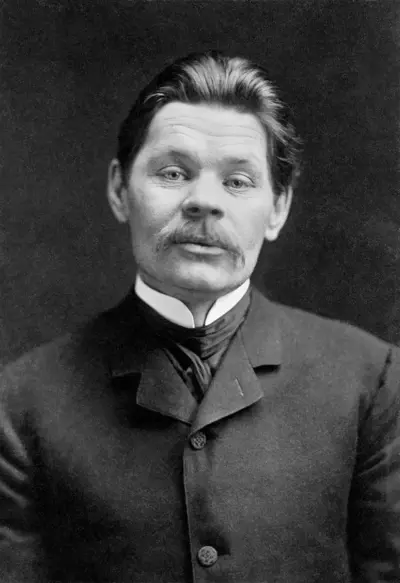
Alexei Maximovich Peshkov, primarily known as Maxim Gorky (Russian: Макси́м Го́рький), was a Russian and Soviet writer, a founder of the socialist realism literary method, and a political activist. He was also a five-time nominee for the Nobel Prize in Literature. Prior to his renown as an author, he frequently changed jobs and roamed across the Russian Empire; these experiences would later influence his writing. Gorky's most famous works were The Lower Depths (1902), Twenty-six Men and a Girl (1899), The Song of the Stormy Petrel (1901), My Childhood (1913–1914), Mother (1906), Summerfolk (1904) and Children of the Sun (1905). He had associations with fellow Russian writers Leo Tolstoy and Anton Chekhov; Gorky would later mention them in his memoirs.
