Maxim Gorky Quotes
[There should be a] veracious history of all the atrocities and havoc inflicted on our country by its former masters; it must show all the loathsome hatred felt by the beasts of prey who had had their claws cut and their teeth drawn …. It will convince the good-natured and the soft-hearted that a capitalist is no longer a human being, but a creature in which an insane lust for profit has consumed every vestige of humanity. This history must be a record of all the blood shed by the capitalists for the sole purpose of maintaining their accustomed conditions of life, the comfortable, delightful, thoroughly corrupt life of two-legged beasts fattening themselves on other people's strength.
Aleksei Maximovitch Peshkov. When some people currently refer to “class warfare” this is the kind of polemic from the left that parallels the rightist propaganda on the other side. In both cases, the worst examples of behavior of a groups is attributed to the class as a whole.
Maxim Gorky 1868-1936, Russian Writer, The People Must Know Their History!,” Culture and the People, 1939
Sourced by: Eigen's Political and Historical Quotations

This quotation distressed many ultra rightists who otherwise were avid followers of Mises. See {632407} for another quotation that distressed many European conservative devotees of Mises.


Both nations’ colonies were amongst the cruelest in human history with huge numbers of black Africans murdered and mutilated if they would not work in the mines for terrible wages or spoke against the brutal colonial rule.

That is exactly what happened. The Spanish raped and interbred with the native women in the Americas and it was their offspring who ended up dominating South and Central American societies.


St. Domingue was the name of Haiti which had had the only successful national slave revolt, but it was incredibly bloody with many casualties.


This early draft was favored by the Northern Delegates but castigated by the Southerners for its criticism of the King England for supporting the slave trade. This is another example of Jefferson’s antipathy to slavery, a puzzle for historians, since he was himself a Southern slave owner at the time but never freed his own slaves.


The “enemy of the human race” is the Devil, Note that the Pope labels as “allies” of the Devil those who advocate and participate in slavery. Slavery was not only immoral, but the Devil was behind it all. The fact that slavery persisted on a massive scale by Catholic countries illustrates that while the Pope was a powerful leaders and figure, even he could not influence all the “sinners.”


This quotation is interesting for two reasons. First it is a good example of the twisted logic of some of the Slavery apologists who claimed that the Negro slave was better off than the free wage earner. The second reason is that it illustrates the norms of the treatment of the working man before the Civil War. The union movement would change the situation for the free laborer over the next century and then holidays and worker rights became normalized in American society. See {641290} for another of his absurd arguments.
This is one of the major reasons that Slavery was so hard to end in the South. At the time, the dollar value of the Southern slaves was greater than the value of all the land, factories, inventory, and capital equipment of the South. Slaves were not only capital, they were the largest component of Southern capital and Southern wealth. There were numerous ideas of paying slave owners for the freedom of their slaves, and if this was done, it would have been far less expensive in money alone than the Civil War cost. However, the Southern leadership, like Fitzhugh, were totally intransient with culture and customs—indeed the Southern concept of manhood—was dependent in Slavery. The result was that no compensation was paid to slave owners and the South was impoverished as a result of its capital loss and it would not recover for 150 years.

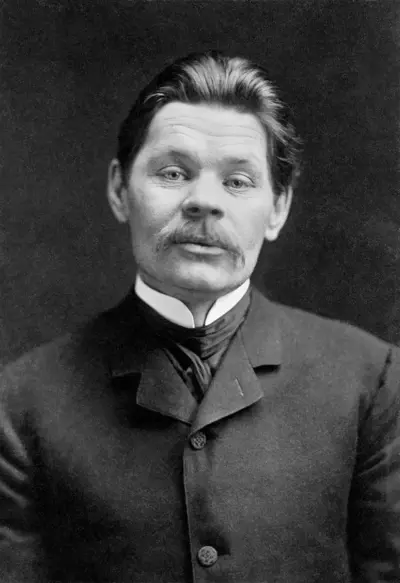
Alexei Maximovich Peshkov, primarily known as Maxim Gorky (Russian: Макси́м Го́рький), was a Russian and Soviet writer, a founder of the socialist realism literary method, and a political activist. He was also a five-time nominee for the Nobel Prize in Literature. Prior to his renown as an author, he frequently changed jobs and roamed across the Russian Empire; these experiences would later influence his writing. Gorky's most famous works were The Lower Depths (1902), Twenty-six Men and a Girl (1899), The Song of the Stormy Petrel (1901), My Childhood (1913–1914), Mother (1906), Summerfolk (1904) and Children of the Sun (1905). He had associations with fellow Russian writers Leo Tolstoy and Anton Chekhov; Gorky would later mention them in his memoirs.
