Josip Broz Tito Quotes
I knew that many things were wrong... I witnessed a great many injustices... But it was my revolutionary duty at the time not to criticize and not to help alien propaganda [against the Soviet Union], for at that time it was the only country where a revolution had been carried out and where Socialism had been built. I considered that propaganda should not be made against that country; that my duty was to make propaganda in my own country for Socialism.
While he disagreed with Russian policies in any cases, he kept his criticism private but strove to maintain Yugoslavia as a Socialist state and part of the Soviet lock but independent. As his policies more and more deviated from Russian policies, Stalin tried to have Tito assassinated as Tito had his own independent policies on relations with the West.
Josip Broz Tito, 1892-1980, President of Yugoslavia, Quoted in Jasper Ridley, Tito: A Biography
Sourced by: Eigen's Political and Historical Quotations

This memo was written a few days before his death and it was the last document he wrote. The communists tended to use the word “socialist” so they could make it seem that the Soviet Bloc was allied or part of the same grouping as the Scandinavian countries, India and other countries that were neither ideological communists nor controlled by the Russian or any other Communist Party. Those nations, in contrast tended to use the word, “socialist” to distinguish themselves from the Communist countries. This mostly confused many Americans. Some conflated the socialist countries and the communist countries making no distinctions. Others, like most European politicians kept the distinction in mind. Most Americans were confused as the Red Scare perpetrators tended to conflate, and the liberals tended to distinguish.

This letter caused the Labor Government of Ramsay MacDonald to lose power to the Conservatives. The Conservatives claimed that the British labor movement was in cahoots with the Russian Communists to use British unions to promote Communism and spread propaganda. In 1924 many Laborites claimed that the letter was a forgery and had been planted by the Conservatives who had pulled other dirty tricks before to smear Labor. However, all the British newspapers ran copies of the letter and Labor lost the election. Historians almost all agree that the letter is a forgery because in other parts of the letter, talking about the Russian program, several errors were made describing the Communist program at the time. Gregory Zinoviev, a high ranking member of the Russian Cominterm, would almost certainly have not made these mistakes. Regardless of the fact that it is a forgery, to this day, it is still referred to as the “Zinoviev Letter,”


The British suspected that the Turks of Anatolia were complicit with Bolshevism


Advocating a revolution against the Karenski provisional government: Vladimir Lenin
Vladimir Lenin

This was one of the first of the world communist leaders who had concluded that the Russian communist state and its revolution had failed. Russia of 1923 was perceived as too dictatorial and not democratic enough. At the same time they thought Russia had not only sold out the democratic nature of communism but also the economic as well by having too much private property and making economic deals with Western capitalists giving concessions of all kinds to Krupp and other major Multinational companies to try and develop international trade and investment. Politically the communist critics thought Russian communism too left wing and undemocratic and economically too right wing and capitalistic.

This was the basic document issued after the Russian Revolution establishing the basic legal and economic structure of the new Soviet State.
This was the basic document issued after the Russian Revolution establishing the basic legal and economic structure of the new Soviet State.

Socialist International Anthem. Also adopted by the Communists


This is a very important historical, political quotation. The conservatives have since the Russian Revolution conflated socialism and communism. However, here in 1932 the leader of the American Socialist Party had already described the Communist Revolution in Russia as a failure of founding an acceptable modern state. Nonetheless, even into the 21st century many conservatives describe Thomas as a Communist. See {626692} for his distinction between Communism and Socialism. The difficulty of modern nation building was explained by Thomas and others but was really not accepted until the many attempts of the early 21st century, some supported by America like Iraq and Afghanistan and the Balkans and others like the “Arab Spring.” Then his early wisdom on this point became more appreciated.

This is an example of what made the Cold War so difficult. The Italian Communists had great misgivings about the Russian version of Communism that tended to abuse human rights and try and control other countries. However, when the Russian Communists were under world attacks by the West, as with their incursion into Hungary, he urged that all the Communists stick together and defend the Russians even for policies that they thought wrong. On the West side, the same thing occurred. The United States tolerated and supported a number of terribly oppressive dictatorships that were virulently anti-Communist. Polarization was the international norm.
This was a big factor that made the Red Scare so damaging.
Vladimir Lenin. While Lenin was of this view, Stalin and other hard liners disagreed. They not only imposed their brand of communism on their own people via force with terrible consequences for any dissidents, but the Soviet Army imposed Communism on most of the states of Eastern Europe, and those states in turn used their Armies and secret police to impose it on their own citizens.

After the 1917 Russian Revolution many of the Western Countries sent troops to Russia where they aided the Whites against the Reds. When the Red Bolsheviks prevailed, there were many attempts to diplomatically and economically undermine the Communist government. This caused a unity among different Russian factions. Sforza urged leaving them alone and letting the Bolsheviks fail by their own ideology. Most Western nations and the United States did not agree with him.

Harriman at that time was the United States Ambassador to Russia and one of President Roosevelt’s closest advisers. There were those who claimed that the Roosevelt administration was very naïve about the potential danger of Stalin. This statement as well as others like it, show that the administration was not so naïve and ignorant.


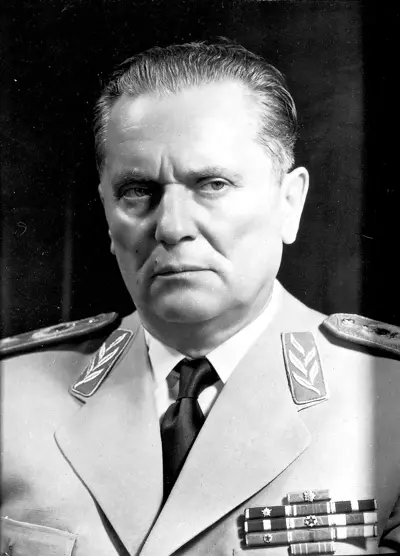
Josip Broz, commonly known as Tito (/ˈtiːtoʊ/; Serbo-Croatian Cyrillic: Тито, pronounced [tîto]), was a Yugoslav communist revolutionary and statesman, serving in various roles from 1943 until his death in 1980. During World War II, he was the leader of the Partisans, often regarded as the most effective resistance movement in occupied Europe. He also served as the president of the Socialist Federal Republic of Yugoslavia from 14 January 1953 until his death on 4 May 1980.
