Wole Soyinka Quotes
History teaches us to beware of the excitation of the liberated and the injustices that often accompany their righteous thirst for justice.
Soyinka, Wole. The Burden of Memory, the Muse of Forgiveness. Oxford University Press, 1999, p. 57.


Charles I had caused the death of his subjects with impunity and was called to account. However, the English Parliament did not know what specific crime the King had committed. Kings had executed people, guilty of crimes and otherwise, for centuries. For what could a king be accountable. Cooke developed the crime of Tyranny and drew up and presented the indictment for that. The King was found guilty and executed. This was the first time in legal history that a ruler was called to account for crimes committed against his own people. It became the foundation for many trials thereafter including that of Saddam Hussein in 2006.


The slogan was made famous by James Larkin, 1875–1947, Irish trade union leader who used it frequently and whose memorial statue in Dublin contains the quotation in French, English and Irish.


Marion was the initiator of Guerilla Warfare and he and his men traveled lightly spending much time in the South Carolina swamps. They had few supplies and when chased by the British could not stop to hunt. The British called him the “Swamp Fox”. The American colonists at this point still thought of the British as “their countrymen.”

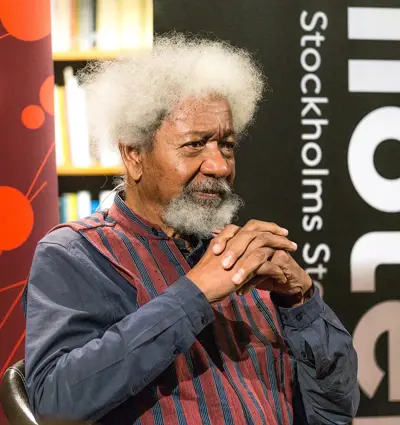
Akinwande Oluwole Babatunde Soyinka, known as Wole Soyinka (pronounced [wɔlé ʃójĩnká]), is a Nigerian playwright, novelist, poet, and essayist in the English language. He was awarded the 1986 Nobel Prize in Literature, the first sub-Saharan African to be honoured in that category. Soyinka was born into a Yoruba family in Abeokuta. In 1954, he attended Government College in Ibadan, and subsequently University College Ibadan and the University of Leeds in England. After studying in Nigeria and the UK, he worked with the Royal Court Theatre in London. He went on to write plays that were produced in both countries, in theatres and on radio. He took an active role in Nigeria's political history and its struggle for independence from Great Britain. In 1965, he seized the Western Nigeria Broadcasting Service studio and broadcast a demand for the cancellation of the Western Nigeria Regional Elections. In 1967, during the Nigerian Civil War, he was arrested by the federal government of General Yakubu Gowon and put in solitary confinement for two years.
