Sunjong Quotes
His Majesty the Emperor of Korea makes complete and permanent cession to his Majesty the Emperor of Japan of all rights of sovereignty over the whole of Korea.
The previous year the Japanese had committed to maintaining the independence of Korea. ({613110}). The Japanese then abrogated their treaty, forced Sunjong to abdicate, assassinated his wife, and annexed the country.
Sunjong, 1874-1926, (Yi Cheok), Emperor of Korea, Treaty with Japan, Aug. 22, 1910
Sourced by: Eigen's Political and Historical Quotations

This was written just before Japan annexed Korea. See {613106}. It is true that Australia with vast land areas at the time was very racist and would only admit whites. America allowed some Asian immigration but limited it severely. After Japan’s defeat in WWII they solved their problem very easily. They practiced birth control and in the early 21st century Japan had a negative population growth. After World War II, there was a huge international emphasis on birth control and family planning as WWII in Asia was in part the result of overpopulation in Japan.
Essentially this writer and intelligence operative had discerned the Japanese reason for its expansionism and wrote about it as early as 1921. The issue really became contentious and culminated in the Japanese surprise attack on Pearly Harbor in WWII, when the U. S. would not let them take over the other countries in Asia. When Bland wrote this, Japan had already annexed Korea. See {613106}. After Japan’s defeat in WWII the solved their problem very easily. They practiced birth control and in the early 21st century Japan had a negative population growth.

The Japanese diplomats of the day maintained that in addition to the special needs of Japan {616181} and {616183}, the “white” powers had colonies and if they left Korea, white nations would simply come in and annex it as a colony. The Japanese saw this as a double standard—white nations could have colonies but Asian nations, no. In reality, Colonialism was fading even in the white nations but Japan was coming to it anew. Their timing was on the wrong cusp of history. The example of Ireland transformed to an independent republic shortly thereafter. For colonialism, the handwriting was on the wall but the Japanese preferred not to look at the trend but the then status quo.


Russia was expansionistic even before the 1914 Russian Revolution with the Communists prevailing. I this case, they had designs on Korea. However, so did Japan and the two would fight in the Russo-Japanese War. Of course neither were concerned with what the Koreans wanted which was independence.


‘Amalgamated’ was a euphemism for ‘being taken over by’. Ito was assassinated shortly thereafter by a Korean patriot who objected to Ito’s takeover of his country.

Korea had been annexed and occupied by the Japanese in 1910. 33 Korean patriots signed the declaration and paid severely for their act against Japan. The Korean patriots were strongly influenced by American President Woodrow Wilson’s statements on the right of self determination.

He was Governor-General of Korea when he made this statement. Most Japanese had nothing but disdain for Koreans and most other ethnicities.


The final decision regarding the attack on Pearl Harbor and war with America had to be made. The Emperor Hirohito, Prime Minister Tojo, the full cabinet and leading elder statesmen were invited. Hara attended as one of the latter class. America had instituted an embargo of critical raw material whose end was contingent of Japan withdrawing from the territory that they had invaded and stop their territorial aggression in Asia, an aggression which some Japanese leaders—notably the military—was absolutely necessary to provide for the growing Japanese population and its increasing standard of living. At the time, an embargo was a powerfully effective weapon, which left Japan only two choices: Withdrawal or War. In modern times nations have chosen to endure and evade embargoes rather than be forced into undesirable positions.


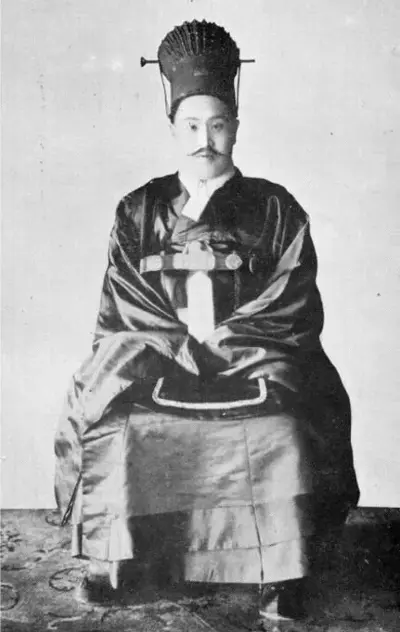
- Born: March 25, 1874
- Died: April 24, 1926
- Nationality:
- Profession:
Sunjong, the Emperor Yunghui, was the second and the last Emperor of Korea, of the Yi dynasty, ruling from 1907 until 1910.
