Karl Marx Quotes
He who before was the money owner, now strides in front as capitalist; the possessor of labor-power follows as his laborer. The one with an air of importance, smirking, intent on business; the other hesitant, like one who is bringing his own hide to market and has nothing to expect but a hiding.
Marx, Karl. Capital: Volume I. Progress Publishers, 1887, p. 123.


In his economic view, managers, accountants, attorneys, owners, shareholders, landlords, were all supported by the workers who have to support themselves and all the others.


At the time, it did seem impossible that labor and capital would ever have harmonious relations. But the notion that slavery would solve the problem is as preposterous as anything ever entered into the American political dialogue. But there were many in the South, and some in the North, who actually believed it. Even 150 years later, while labor and capital relations were much better than pre Civil War, they still could not be described as “harmonious” or “friendly”.


Sinclair had written an expose of the meat packing industry – the Jungle – which used as its setting the Armour meat packing factory. It changed the way the public thought about the industry, the role of government and regulation. President Roosevelt took up the reform role, and got Congress to Regulate the quality and cleanliness of the meat packing industry. Sinclair, however not only wanted that reform, but also wanted the labor wages and conditions reformed. He referred to the Armour plant as the fortress.
Salisbury was a brilliant, effective prime minister, but he was a snob and not a democrat. See {639131}.
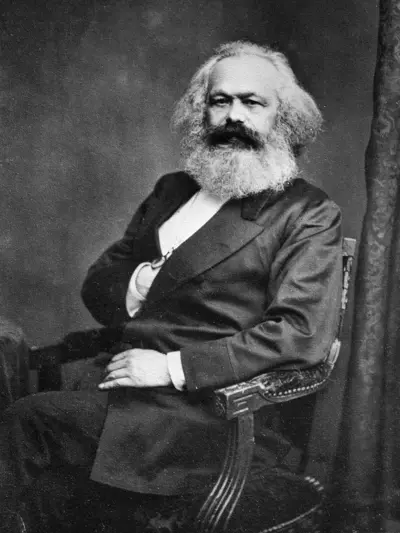
Karl Heinrich Marx was a German philosopher, economist, historian, sociologist, political theorist, journalist and socialist revolutionary. Born in Trier, Germany, Marx studied law and philosophy at university. He married Jenny von Westphalen in 1843. Due to his political publications, Marx became stateless and lived in exile with his wife and children in London for decades, where he continued to develop his thought in collaboration with German thinker Friedrich Engels and publish his writings, researching in the reading room of the British Museum. His best-known titles are the 1848 pamphlet The Communist Manifesto and the three-volume Das Kapital (1867–1883). Marx's political and philosophical thought had enormous influence on subsequent intellectual, economic and political history. His name has been used as an adjective, a noun, and a school of social theory.
