Plutarch Quotes
He [Caesar] loved the treason, but hated the traitor.
Plutarch. Plutarch's Moralia. Translated by Frank Cole Babbitt, vol. 3, Harvard University Press, 1931, p. 195.


McCarthy was one of the most interesting political phenomena of politics in the 1950s. He was an alcoholic megalomaniac who made wild accusations about communists everywhere and that the Secretary of State and other politicians were communists. He claimed to have a list of thousands of communists in high positions of government. His accusations were so dramatic that most people assumed that there were facts behind them otherwise no rational man would say such things. But it turned out that not a single accusation was ever proven. When McCarthy was esposed, he was censured by the Senate and he lost most of his political credibility and shortly thereafter died as a result of his severe alcoholism.


Before the 1968 election, President Johnson, and gotten the North Vietnam Communists to agree to Peace Talks with the U. S. and South Vietnam. Then Candidate Nixon thought that if the peace talks were ongoing and making progress, there would be more support for the Democrats and Nixon's opponent Hubert Humphrey. So Nixon secretly send a secret emissary to South Vietnamese President Nguyen Van Thieu telling him that he would not get a very good deal because President Nixon claimed that President Johnson was too eager to end the Vietnam war. He suggested that if Thieu boycotted the peace talks, then when Nixon was elected, he would guarantee a much better deal for South Vietnam and Thieu personally. President Thieu boycotted the peace talks and there could be no progress. However there is a Federal Law, the Logan Act, that makes it a felony for a private American citizen to conduct or interfere with foreign policy or negotiations with a foreign government. President Johnson found out about Nixon—s sabotage of the Peace Talks, called Nixon and threatened him with prosecution if he interfered further. LBJ had decided that with the left wing at odds with the U. S. Government over the Vietnam War, a prosecution of Nixon would cause the Right Wing to challenge the government also and the country didn—t need further polarization. He would do that only if Nixon did not heed the President—s warning. But when Nixon won the election and became President, he was terribly anxious that his pre-election crimes would be made public, and spent much of his time and staff effort trying to find out who knew about his politically self-serving felony and who might make his crime public. See {583264}.

“Lord Haw Haw” was the name that he used in his propaganda broadcasts from Germany to England. Despite the fact that the broadcasts were anti-British and pro German, many in Britain listened to him regularly. He was very witty and many of his criticisms of British society were views held by many patriots in Britain. As pure entertainment, he was better than most of the BBC broadcasts during WWII. At the end of the war, Joyce was captured, tried and executed for treason.

Ingersoll was considered to be the greatest orator and political thinker of his day, but his overt atheistic views curtailed his elected political career.


In the 1912 Republican nominating convention, Theodore Roosevelt was contesting the renomination of President William Howard Taft whom he had originally picked as the Republican nominee four years earlier. Then Senator Harding gave the nominating speech for Taft. In it he described Roosevelt as:

Arnold was not just any senior officer, but one who had been a great fighter against the British not only, leading his men brilliantly but exposed himself to great danger in the process. He had been such a hero that Washington could not imagine how an officer like that could become a traitor to the cause. Arnold’s treasom had nothing to do with ideology or the issues of the war. Arnold felt that he had not been appreciated for his efforts (his commanding officer gave him no credit for the most heroic and effective military battlefield leadership up to that point in the war) and became disaffected.

He held up tools made by the Stanley Tool Company which had announced that they were relocating to Bermuda to avoid paying American taxes. The company changed its mind after this sort of publicity.


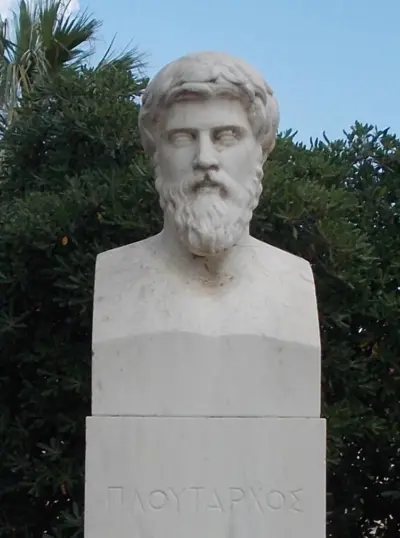
Plutarch (/ˈpluːtɑːrk/; Greek: Πλούταρχος, Ploútarchos; Koine Greek: [ˈplutarkʰos]; AD 46–after AD 119) was a Greek Middle Platonist philosopher, historian, biographer, essayist, and priest at the Temple of Apollo. He is known primarily for his Parallel Lives, a series of biographies of illustrious Greeks and Romans, and Moralia, a collection of essays and speeches. Upon becoming a Roman citizen, he was named Lucius Mestrius Plutarchus (Λούκιος Μέστριος Πλούταρχος).
